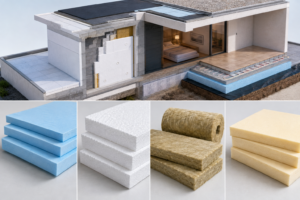
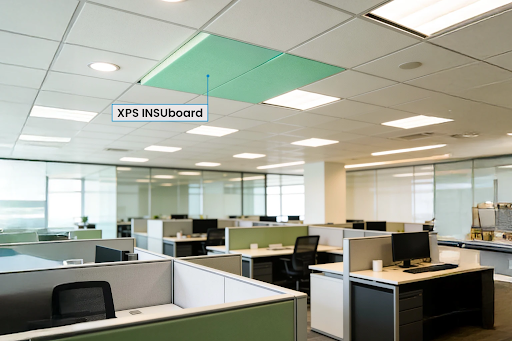
Modern construction in India faces extreme heat, monsoons, and rising energy costs. Effective roof insulation is essential for sustainable design. Inverted roof systems, where insulation sheets sit above waterproofing membranes, are gaining popularity for protecting structures and improving thermal efficiency. This blog looks at INSUboard Roof Grade by Supreme Petrochem Ltd, a high-performance extruded polystyrene (XPS) solution designed for these systems. It shows how this product delivers lasting thermal control and durability.
From technical specifications to real-world applications, we’ll explore INSUboard’s role in inverted roof systems in India, compare it with alternatives, and address common design questions. As a product from one of India’s top insulation companies, INSUboard Roof Grade is known for its compressive strength and low water absorption. This makes it ideal for flat roofs in urban high-rises and commercial buildings. Expect insights on energy savings, installation best practices, and reasons it performs better in humid conditions.
What Is an Inverted Roof System and INSUboard’s Role?
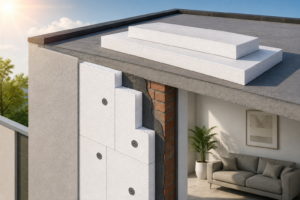
An inverted roof system in India reconfigures traditional setups by layering rigid insulation sheets over the waterproofing membrane, then covering it with ballast, pavers, or screed. This shields the membrane from UV rays, thermal shocks, and foot traffic, extending its lifespan by 2 to 3 times compared to conventional under-membrane insulation. In India’s hot-humid climate, where roof temperatures can reach 70°C in summer, this design prevents heat from penetrating slabs and stabilises indoor temperatures.
INSUboard Roof Grade enhances performance by providing lightweight, high-strength XPS boards, typically with a density of 30 to 32 kg/m³, and negligible water absorption of less than 0.7% by volume. Positioned directly above the membrane, it reduces conductive heat transfer while resisting compression from loads above. Supreme Petrochem, a leading insulation company in India, designs these boards for overdeck applications, ensuring they withstand monsoon pooling without degrading, unlike permeable materials that absorb moisture.
INSUboard Roof Grade: Technical Specs for Thermal Efficiency Roofing
INSUboard Roof Grade features a thermal conductivity of 0.028 to 0.030 W/m·K, which translates to stable R-values around 4.2 to 4.5 per inch of thickness. This is much better in wet conditions than open-cell foams. Its compressive strength, rated at 250 to 300 kPa at 10% deformation, supports heavy ballast loads such as concrete pavers, making it excellent for inverted roof insulation on commercial terraces. Boards are available in standard sizes of 1.2m x 2.4m and thicknesses from 25 to 100mm for easy handling on site.
This EPS roof insulation board equivalent, though XPS-based and closed-cell, lowers peak roof temperatures by 6 to 8°C, reducing cooling loads by 20 to 30% in air-conditioned buildings, according to industry studies on similar systems. Among insulation companies, Supreme Petrochem’s zero-CFC formulation meets IGBC standards, making it a preferred choice for green certifications.
How EPS Insulation Boards Elevate Flat Roof Performance
EPS roof insulation board, like INSUboard, works by trapping air in closed cells, drastically reducing heat loss through conduction, the main issue with flat roofs. In inverted roof systems in India, placing it above the membrane takes advantage of rainwater as a minor thermal mass, helping to stabilise temperature fluctuations. Tests show these setups maintain U-values below 0.4 W/m²K, cutting heat gain in half compared to uninsulated slabs.
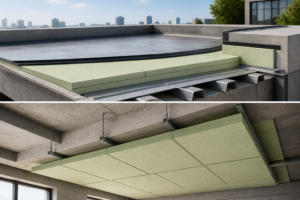
For ceiling insulation hybrids, thinner INSUboard layers under slabs work in conjunction with overdeck use, creating two barriers. This is vital for Mumbai high-rises, where solar radiation exceeds 800 W/m², increasing HVAC costs by 40% without proper thermal efficiency roofing.
Inverted Roof Insulation Design: Material Selection Guide
Designing an inverted roof system in India starts with assessing the site, focusing on slab gradient, load capacity, and exposure. Choose INSUboard Roof Grade for its combination of low thermal conductivity for insulation and high strength for ballast stability. The sequence of layers should be: membrane, geotextile separator, 50-75mm INSUboard, drainage mat, and pavers. Avoid overlaps without sealing to prevent wind uplift.
A common oversight in popular blogs is neglecting drainage during monsoons. INSUboard’s impermeability, with less than 1% absorption, addresses this, unlike EPS, which can retain 2 to 4% water over the long term. Pair with filter fabric to prevent fine materials from moving, ensuring a service life of over 50 years.
Supreme Petrochem INSUboard Roof Grade: Key Benefits
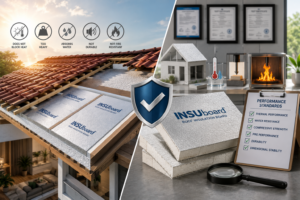
Supreme Petrochem’s INSUboard Roof Grade offers unmatched durability, with no sagging or dusting for decades. This reduces lifecycle costs by 25% compared to fibreglass. Its fire rating, classified as Class 0 for spread, meets urban codes, while its lightweight nature minimises dead weight, making retrofitting easier for older structures. In green buildings, it reduces operational carbon emissions by enabling smaller chillers.
For roof insulation, benefits include 15-25% lower energy bills. Insulation companies recommend it for scaling from residential terraces to industrial sheds.
EPS vs XPS Insulation for Inverted Roofs: Detailed Comparison
XPS, like INSUboard, outperforms EPS in inverted roofs due to its better cell structure and strength. XPS retains 95% of its R-value when wet, while EPS drops to 70-80%. EPS works well in dry cavities but struggles under sustained loads or in moist conditions.
| Property | INSUboard Roof Grade (XPS) | EPS Boards |
| Cell Structure | Closed | Semi-closed/open |
| Water Absorption | <0.7% INSUboard | 2–4% |
| Compressive Strength | 250–300 kPa | 100–150 kPa |
| R-Value Stability (Wet) | 95% retention | 70–80% |
| Cost (per m², 50 mm) | Moderate | Lower initial |
| Best for Inverted? | Yes—load/moisture | No—dry apps only |
This advantage addresses gaps in generic insulation guides that overlook the extremes of Indian wet-bulb temperatures.
Boosting Thermal Efficiency Roofing in Flat Roofs
To maximise thermal efficiency, roofing, taper INSUboard for drainage at a 1:100 slope, achieving U-values below 0.25 W/m²K at 75mm thickness. Combine with cool coatings for an additional 10-15% gain. In warm roofs where insulation is below the membrane, it also benefits ceiling insulation. However, inverted roofs excel in providing protection.
Studies confirm that polystyrene roof insulation can cut peak loads in half, which is crucial as India’s construction sector aims to reduce energy consumption by 40% by the year 2030.
Installation Best Practices for Longevity
Prepare by power-washing the slabs and applying a primer-bitumen membrane. Place INSUboard in staggered rows with butt joints over geotextile. Secure the edges against uplift; use screed or pavers per design loads. Inspect for shifts after monsoons, which are minimal thanks to INSUboard’s rigidity.
Maintenance involves yearly visual checks. Its rot-proof quality eliminates the need for frequent replacements common with wool-based systems.
Real-World Case Studies in India
In a corporate office in Bangalore, installing INSUboard lowered summer cooling costs by 22% and kept indoor temperatures stable, reducing equipment downtime by over 30%. Residential towers in Mumbai used 40mm boards for terraces, reporting temperatures 7°C cooler indoors without extra air conditioning. These examples demonstrate the effectiveness of inverted roof insulation.
Frequently Asked Questions
It’s an XPS board optimised for overdeck use, offering high strength and low absorption to protect membranes over the long term.
Its low thermal conductivity reduces heat gain by 6 to 8°C, leading to 20 to 30% savings in cooling costs.
XPS (INSUboard) provides superior wet performance and load-bearing capacity.
INSUboard Roof Grade offers a balanced approach to cost, R-value, and durability.