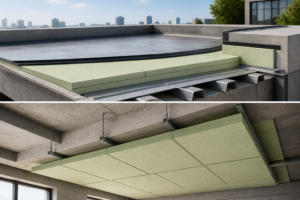
Every facility manager and building owner faces a common challenge: how to manage costs, ensure occupant comfort, and reduce long-term maintenance demands. The solution lies in the quality of insulation selected at the beginning. A well-insulated building is not only more comfortable today but also thermally and structurally stronger throughout its life. India’s buildings account for about 30 per cent of national electricity consumption, and NITI Aayog expects this figure to rise more than six times by 2047. Therefore, the insulation material chosen during construction or renovation is one of the most important long-term financial decisions a facility can make.
In this blog, INSUboard, the thermal insulation brand of Supreme Petrochem Ltd, India’s top insulation company in the XPS segment, discusses what it means to future-proof a facility with durable, high-performance insulation. This guide covers the properties that impact long-term performance, as well as the financial reasons for investing in quality insulation from the start, drawing on verified product data and building science principles.
Why Building Insulation Is a Long-Term Investment, Not a One-Time Cost
The common mistake when assessing insulation is treating it as a cost to minimise rather than an investment to optimise. These two approaches lead to very different outcomes. A cheaper, lower-quality insulation may lower upfront costs by 10 to 15 percent, but if its thermal performance deteriorates within three to five years due to moisture, compression, or delamination, the true cost over 20 years becomes significantly higher, both in energy bills and replacement labour.
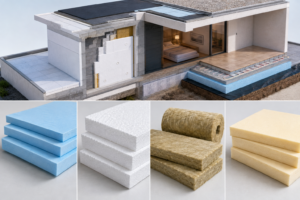
INSUboard XPS (Extruded Polystyrene) boards are designed to remain in walls and roofs throughout the life of the building, eliminating the need for replacement cycles. This is due to the closed-cell manufacturing process, where each cell is fully surrounded by polystyrene walls, preventing water penetration. The board maintains its thermal conductivity of 0.0289 W/m.K without degradation during India’s monsoon seasons, coastal humidity, and temperature extremes.
The average payback period for correctly installed insulation in India is about three years, after which energy savings provide a net positive return for the rest of the building’s life. For commercial properties with large roof areas and significant air conditioning demands, such as warehouses, factories, and pharmaceutical plants, the savings over 20 years can vastly exceed the initial installation cost.
What Makes Insulation Boards Durable? The Properties That Matter Most
Not all insulation is equal, and not all insulation materials age the same way. Knowing which physical properties determine long-term durability helps facility managers evaluate products based on their performance, not just price.
The four key properties for long-lasting insulation performance are:
- Water absorption — the most critical factor in Indian conditions. Insulation sheets with open-cell structures absorb water during the monsoon, thereby losing thermal performance over time. INSUboard’s closed-cell XPS structure has negligible water absorption, ensuring the board’s K value of 0.0289 W/m.K remains steady throughout its life.
- Compressive strength — indicates whether the insulation can support loads without deforming. INSUboard’s Roof Grade boards have a compressive strength above 300 kPa, making them suitable for pedestrian and vehicle traffic roofs, roof gardens, and heavy load applications. Floor Grade boards are rated above 500 kPa for industrial and cold storage floors. Deformation under load creates performance gaps, uneven surfaces, and ultimately thermal bridging.
- Dimensional stability — the ability to maintain shape through temperature changes. Insulation that expands and contracts significantly will eventually detach from its base, creating gaps that compromise thermal and moisture performance. XPS’s closed-cell structure provides inherent dimensional stability across India’s varied climate.
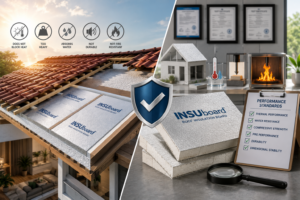
- Fire retardancy — INSUboard is made with flame-retardant additives that meet DIN 4102 Part 1 Class B2 standards and is self-extinguishing when the external flame source is removed. Class B1 is available for projects with stricter fire safety requirements.
Each of these properties contributes to the total cost of ownership over time. A building with insulation sheets that uphold all four properties for 30 years incurs no replacement costs. In contrast, a building fitted with open-cell EPS or glasswool that deteriorates over 10 to 15 years will need partial or full re-insulation, with labour costs typically exceeding the original material price.
How Insulation Reduces Building Maintenance Costs Over Time
Building maintenance costs generally fall into two categories: those caused by poor thermal management and those caused by moisture damage. Properly specified insulation addresses both issues.
On the thermal side, an uninsulated building forces its HVAC systems to work much harder to maintain target temperatures, leading to increased equipment wear, more frequent servicing, and shorter compressor lifespans. INSUboard emphasises that well-insulated buildings require smaller HVAC systems, lowering capital costs for mechanical equipment. A building that needs a smaller air conditioning unit will spend less on equipment over 20 years than one using a larger unit to compensate for thermal losses.
On the moisture side, insulation that prevents condensation within the building envelope greatly reduces the risk of corrosion, mould, and structural damage. In India’s coastal and humid regions, such as Mumbai, Chennai, Kochi, and Kolkata, condensation within wall and roof assemblies significantly drives up maintenance costs. INSUboard’s negligible water absorption makes it a moisture barrier within the envelope, protecting structural elements from condensation-related deterioration. This is particularly crucial in industrial facilities and cold storage, where temperature differences create strong condensation pressure at the building envelope.
INSUboard by Supreme Petrochem Ltd: India’s Only Domestically Manufactured XPS
Understanding the long-term value of INSUboard requires examining the company behind it. Supreme Petrochem Ltd (SPL) is a joint venture promoted by The Supreme Industries Ltd, the largest plastics processor in India, and R. Raheja Investments Pvt Ltd. SPL began operations in 1995 and now holds more than 50 percent of the Indian polystyrene market, with a production capacity of 272,000 TPA and exports to over 100 countries.
In 2007, SPL established India’s first and only integrated XPS insulation plant, with an annual output of 100,000 m³. The manufacturing technology was sourced from Huntsman, a leading polystyrene producer in the USA, with basic engineering support from ABB Lummus Crest. The plant uses environmentally friendly blowing agents free of CFCs and HCFCs, making INSUboard one of the most environmentally responsible insulation options available in India. This has been part of the manufacturing process since its beginning.
INSUboard has certifications from the Indian Green Building Council (IGBC), GRIHA (for under-deck, over-deck, and wall insulation), NCCD (cold storage), ISO 9001 (quality management), ISO 14001 (environmental management), and OHSAS 18001:2007 (occupational health and safety). This makes it one of the most highly certified insulation products available in India, and it is XPS, not standard EPS.
| Specification | Value | Why It Matters for Longevity |
| Thermal Conductivity (K) | 0.0289 W/m.K | Stable performance — does not degrade over building life |
| Roof Grade Density | > 34 kg/m³ | Structural integrity under load; resists deformation |
| Floor Grade Density | > 38 kg/m³ | High-load bearing for industrial floors and cold storage |
| Roof Compressive Strength | > 300 kPa | Handles pedestrian and vehicular traffic on roofs |
| Wall Compressive Strength | > 180 kPa | Durable under cladding and cavity wall systems |
| Water Absorption | Negligible (closed cell) | No performance loss during monsoon or humid conditions |
| Expected Lifespan | Life of the building | Zero replacement cost over the building’s lifetime |
| Fire Retardancy | Self-extinguishing (DIN 4102 B2) | Compliant with building and fire safety codes |
| Blowing Agents | Environmentally friendly (CFC/HCFC-free) | GRIHA and IGBC green building approved |
Applications Where Long-Term Durability of Insulation Sheets Matters Most
The case for the durability of INSUboard applies to all types of applications; however, it has the most financial significance in these areas:
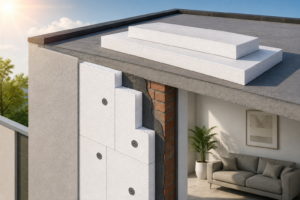
• Industrial and manufacturing facilities, which have large roof areas that experience continuous thermal load. If insulation fails on a factory roof, it can lead to re-roofing, disrupting production. INSUboard’s over-deck application protects the waterproofing membrane, helping the roof assembly last longer overall.
• Cold storage and pharmaceutical facilities need precise temperature control. INSUboard Floor Grade boards, which have a compressive strength above 500 kPa, are designed for high-load cold storage floors. Facilities that use inadequate insulation risk increased energy costs and potential product loss when thermal performance drops.
• Commercial office buildings and retail spaces see a direct link between occupant comfort and productivity. High internal temperatures resulting from poor insulation can reduce cognitive performance and increase absenteeism. Energy savings from properly selected insulation sheets lead to lower operating costs for the owner and improved indoor conditions.
• Residential buildings in India often have insufficient insulation. INSUboard works well for roofs, walls, and floors in homes, while INSUtile offers a convenient retrofit option for existing flat roofs without civil disruption.
• Refrigerated vehicles and mobile cold chain solutions require structural integrity to handle vibration and temperature changes. INSUboard is also effective for insulating refrigerated vehicles, showing its versatility beyond static applications.
In these scenarios, the financial argument remains the same: investing in durable insulation from the start is always cheaper than the combined costs of energy waste, excessive HVAC workload, and re-insulation over 20 years.
How to Future-Proof Your Building with the Right Insulation Strategy
Future-proofing a building through insulation involves a layered strategy that protects the entire building envelope. Here are the principles that maximise long-term value:
• Insulate the entire envelope, focusing on sun-facing surfaces: INSUboard suggests adding insulation to all exterior walls and roofs for the best results. Where budget constraints exist, prioritise sun-facing walls and roofs, as they provide the highest thermal return for your money due to their significant solar exposure.
• Consider material quality over unit cost: Instead of asking, “What is the cheapest insulation sheet?” ask, “What is the cost per degree of thermal resistance maintained over 20 years?” INSUboard’s verified K value of 0.0289 W/m.K, which remains stable, means its long-term cost is lower than that of materials that degrade over five to ten years.
• Incorporate insulation into the structural design: Adding insulation later can create thermal bridges and performance issues. Specifying INSUboard during the design phase enables integrating cavity wall systems, EIFS finishes, and overdeck configurations into a single unit.
• Use certified products with verifiable data: INSUboard comes with GRIHA, IGBC, ISO 9001, and ISO 14001 certifications, which provide independently confirmed performance specifications. This is vital when a facility’s green building rating depends on energy performance metrics.
• Prepare for retrofitting when new construction isn’t feasible: INSUtile offers a straightforward roof insulation solution for existing flat concrete roofs. EIFS enables the direct application of INSUboard panels to current walls with a decorative finish, avoiding major civil work.
Making a facility future-proof with the right insulation is one of the best capital decisions for building owners and facility managers. A well-insulated building requires fewer HVAC replacements, lowers energy costs, requires less maintenance, and creates a more comfortable environment. INSUboard by Supreme Petrochem Ltd produces India’s only domestically manufactured XPS insulation, backed by 100,000 m³ of annual capacity, verified performance specifications, and the reputation of a company with over 50 per cent market share in Indian polystyrene.
Frequently Asked Questions
INSUboard XPS insulation stays in place for the building’s entire life once installed in walls or on a roof. No replacements are required. Its closed-cell structure prevents water absorption and maintains the material’s structural and thermal properties. This sets XPS apart from open-cell materials like glasswool or standard EPS, which may degrade over time.
Yes. The average payback period for correctly installed building insulation in India is around three years, after which energy savings yield a net positive return. For commercial and industrial buildings with large roofs and high cooling demands, the total savings over 20 years can far outweigh the original installation cost. Improved insulation also reduces the size of HVAC equipment, decreasing capital expenses.
EPS (Expanded Polystyrene) is made from beads fused together using steam and pressure. Its open-cell structure allows for water absorption over time, which reduces its thermal performance, an issue in India’s monsoon conditions. XPS (Extruded Polystyrene), as used in INSUboard, is produced via a continuous extrusion process that yields a uniform, closed-cell structure. This gives XPS minimal water absorption, better compressive strength, and stable thermal performance. INSUboard is an XPS manufacturer, and its plant in Amdoshi is India’s only integrated XPS manufacturing facility.
For existing flat concrete roofs, INSUtile is the ready-to-use retrofit solution that can be placed directly on the current roof surface without significant civil work. For walls, the EIFS (Exterior Insulation and Finishing System) allows INSUboard panels to be attached directly to existing wall surfaces with a decorative finish on top. Both options make the retrofitting of building insulation practical and cost-effective for older commercial, industrial, and residential buildings.