In this blog, INSUboard, a product of Supreme Petrochem Ltd, explores a key question for any serious building insulation project: what role do high-strength insulation boards play in delivering lasting overdeck insulation performance and ceiling insulation quality? As India’s only manufacturer of Extruded Polystyrene (XPS) thermal insulation boards, with an annual capacity of 100,000 m³ and certifications from GRIHA, IGBC, and ISO 9001, INSUboard brings technical expertise and installation experience that few companies in India can match. Our goal is simple: to drive energy savings in residential and commercial buildings across India, and to ensure every building performs at its thermal best.
The effectiveness of a ceiling insulation system or an overdeck roofing insulation assembly depends on the board’s physical properties. Thermal conductivity governs how much heat passes through; moisture resistance determines how that performance holds up over decades; and, particularly for overdeck insulation, compressive strength insulation determines whether the board survives loads from foot traffic, screed, tiles, vehicles, or roof gardens without deforming. This blog explains why high-strength insulation boards are not merely a premium option but a genuine requirement for any ceiling insulation or overdeck installation intended to perform reliably throughout the building’s full-service life.
What Are High-Strength Insulation Boards and How Do They Work?
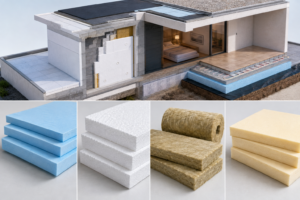
INSUboard XPS boards are made using a fully automated, continuous extrusion process that produces a uniform, closed-cell polystyrene foam matrix. Polystyrene granules are melted with fire-retardant additives and an eco-friendly blowing agent, then extruded to form a smooth foam board with every cell completely enclosed by polystyrene walls. This closed-cell design, unlike the open-cell or bead-fused structure of EPS (Thermocol), gives INSUboard its combination of compressive strength, insulation performance, and negligible water absorption.
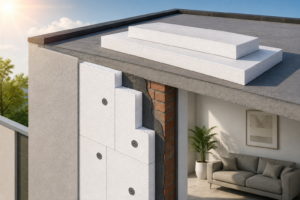
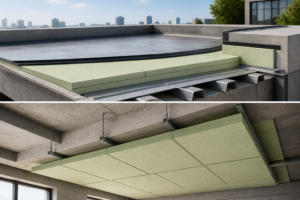
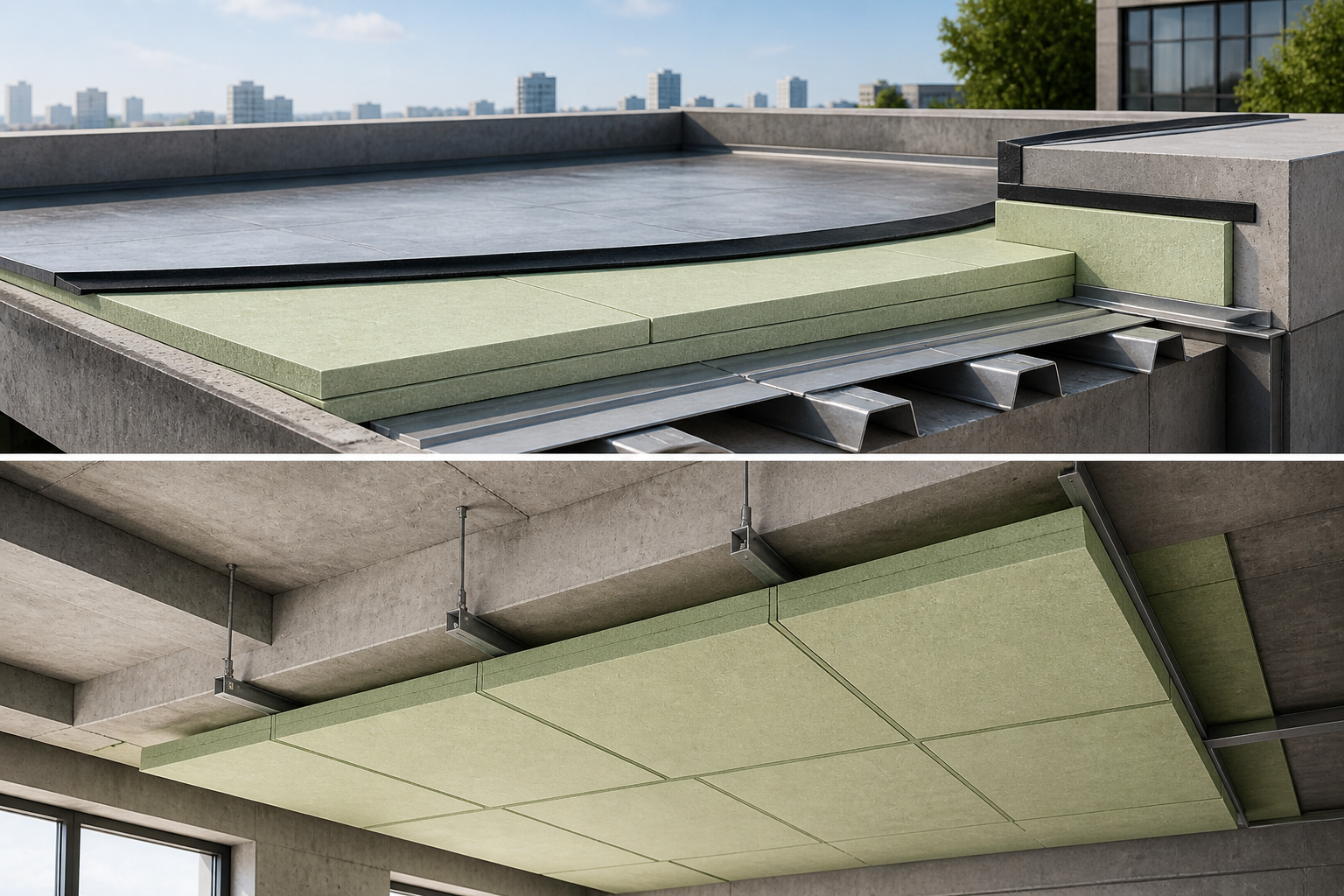
In ceiling insulation (underdeck) applications, the board is fixed directly to the RCC slab in a staggered pattern using stainless steel fasteners and rawl plugs, then a false ceiling is installed below. In overdeck roofing insulation applications, INSUboard is laid over the waterproofing system in a staggered pattern, covered with geotextile fabric, and finished with tiles, cement screed, or gravel. In this overdeck position, the structural insulation board must resist heat transfer from above while simultaneously bearing the full weight of all overlying construction and traffic loads, making compressive strength insulation performance non-negotiable.
Why Compressive Strength Is Critical for Overdeck Roofing Insulation
If an insulation board in an overdeck position is crushed or deformed under load, the effects ripple through the entire roof system. The insulation layer thins and thermal resistance falls; deformed joints can create water pathways; and the waterproofing membrane below is subjected to concentrated loads it was not designed to handle, risking failure and costly repair. INSUboard Roof Grade boards have a compressive strength insulation value greater than 300 kPa, achieved through a uniform, closed-cell extrusion structure, making them a true high-load insulation panel that remains stable under the full range of roof loads throughout the building’s life.
Roof grade boards are suitable for non-traffic roofs with gravel finish, pedestrian and vehicular traffic roofs (including car parks), roof gardens (intensive and extensive), and flat roof refurbishments. Beyond structural performance, the structural insulation board in an overdeck position also protects the waterproofing membrane from direct loads, thermal cycling, and abrasion, significantly extending its service life. INSUboard captures this dual function in the phrase: “protects waterproofing and provides insulation.
How INSUboard Improves Thermal Efficiency in Ceiling and Roof Applications
Residential and commercial buildings in India account for approximately 30% of the country’s electricity consumption, a figure expected to grow more than six times by 2047, according to NITI Aayog data referenced by INSUboard. Properly insulated buildings reduce energy use, improve occupant comfort, and cut carbon emissions. INSUboard XPS boards across all grades achieve a thermal conductivity of 0.0289 W/m.K, one of the lowest values available in any rigid insulation product, owing to the air trapped in each fully closed cell, which is an exceptionally poor heat conductor.
Because each cell is fully enclosed and the board absorbs negligible moisture, INSUboard’s thermal performance does not degrade over time, unlike EPS boards, which allow moisture infiltration through inter-bead boundaries. For ceiling insulation in underdeck applications, this means heat is prevented from radiating down through the concrete slab into the occupied space, substantially reducing the cooling load on HVAC systems. INSUboard notes that well-insulated buildings reduce required HVAC capacity, lowering capital expenditure on cooling and heating equipment, with return on investment from proper insulation typically achieved within approximately three years.
INSUboard by Supreme Petrochem: India’s Leading High-Strength Insulation Board
INSUboard is the XPS thermal insulation board brand of Supreme Petrochem Ltd, jointly promoted by The Supreme Industries Ltd and R. Raheja Investments Pvt Ltd. Supreme Petrochem launched India’s first and only integrated XPS insulation plant in 2007, with an annual production capacity of 100,000 m³. INSUboard is manufactured from GPPS, masterbatch, fire-retardant additives, and an environmentally friendly blowing agent free of HCFCs and CFCs. Certifications include GRIHA, IGBC, GreenPro, ISO 9001:2015, ISO 14001:2015, and OHSAS 18001:2007, with NCCD approval for cold storage applications.
The INSUboard range comprises three purpose-engineered grades: Roof, Wall, and Floor, each with precisely specified compressive strength, insulation, density, and thermal conductivity for its target application:
| Property | Roof Grade | Wall Grade | Floor Grade |
| Application | Overdeck & underdeck insulation | Cavity wall, EIFS, external & internal wall | Industrial floors, cold storage |
| Thermal Conductivity | 0.0289 W/m.K | 0.0289 W/m.K | 0.0289 W/m.K |
| Density | > 34 kg/m³ | > 34 kg/m³ | > 38 kg/m³ |
| Compressive Strength | > 300 kPa* | > 180 kPa* | > 500 kPa* |
*Compressive strength values vary by product thickness and ASTM class. Source: insuboard.com.
The Roof Grade, the primary ceiling insulation boards, and the overdeck roofing insulation specification deliver a density of over 34 kg/m³ and a compressive strength exceeding 300 kPa, making it a genuine high-load insulation panel for the full spectrum of roof applications. The Floor Grade, specified at over 500 kPa, is suitable for the most demanding industrial and cold storage applications. For existing roofs, INSUboard’s INSUtiles can be placed directly over the existing surface without civil work, supporting both new-build and refurbishment projects for residential and commercial buildings alike.
Long-Term Building Performance: Why the Right Board Specification Matters
The case for high-strength insulation boards extends beyond immediate energy savings. A properly specified structural insulation board in an overdeck position shields the waterproofing membrane from solar radiation, thermal cycling, and surface loads, significantly extending its service life and protecting the building structure from water ingress and consequent deterioration. INSUboard’s closed-cell XPS foam maintains its insulating properties indefinitely when shielded from UV radiation (provided automatically by the overlying finish layer), and once installed, no replacement is required for the life of the building.
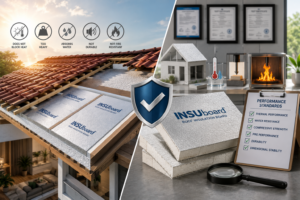
From a fire safety standpoint, INSUboard meets DIN 4102 Part 1 Class B2 requirements, with Class B1 grades available for specific project needs. When exposed to a small flame, the fire-retardant formulation causes the material to self-extinguish upon removal of the flame source without propagating fire, an important characteristic for ceiling insulation and roof applications.
The role of high-strength insulation boards in overdeck insulation performance and ceiling insulation quality is fundamental. INSUboard XPS India’s only domestically manufactured XPS insulation board delivers consistent thermal resistance of 0.0289 W/m.K, the compressive strength insulation needed to carry real-world roof loads, negligible moisture absorption, and performance that lasts the life of the building. Backed by GRIHA, IGBC, GreenPro, and ISO certifications, INSUboard provides the technical confidence and long-term assurance that every insulation project deserves.
Frequently Asked Questions
Compressive strength insulation is critical because the structural insulation board in an overdeck position must support the full weight of all overlying layers, such as screed, tiles, paving, roof garden soil, and traffic, without crushing or creeping. If it deforms, thermal resistance falls, water pathways can form at joints, and concentrated loads may damage the waterproofing membrane below. INSUboard Roof Grade boards exceed 300 kPa, making them a reliable high-load insulation panel throughout the building’s life.
XPS is produced by continuous extrusion, creating a fully closed-cell foam. EPS is made by fusing polystyrene beads, leaving open boundaries where moisture can infiltrate over time, degrading thermal and structural performance. INSUboard’s closed-cell structure absorbs negligible moisture, maintaining a thermal conductivity of 0.0289 W/m.K throughout the building’s life. INSUboard also delivers higher compressive strength insulation than EPS at equivalent density, making it the preferred high-strength insulation board specification for demanding overdeck roofing insulation and ceiling insulation applications.
Yes. For new builds, INSUboard Roof Grade is laid over the waterproofing system in a staggered pattern and covered with the chosen finish. For existing flat roofs, INSUtiles can be placed directly over the existing surface without civil work. For underdeck ceiling insulation refurbishment, boards are mechanically fastened to the existing concrete ceiling before false ceiling installation, with no major structural intervention required.
Once installed, INSUboard is designed to remain effective throughout the building’s life with no scheduled replacement. INSUboard’s FAQ documentation estimates that the typical return on investment from proper insulation installation is achieved within approximately three years, after which the building benefits from reduced energy consumption, improved comfort, and lower HVAC capacity demands for the rest of its service life.