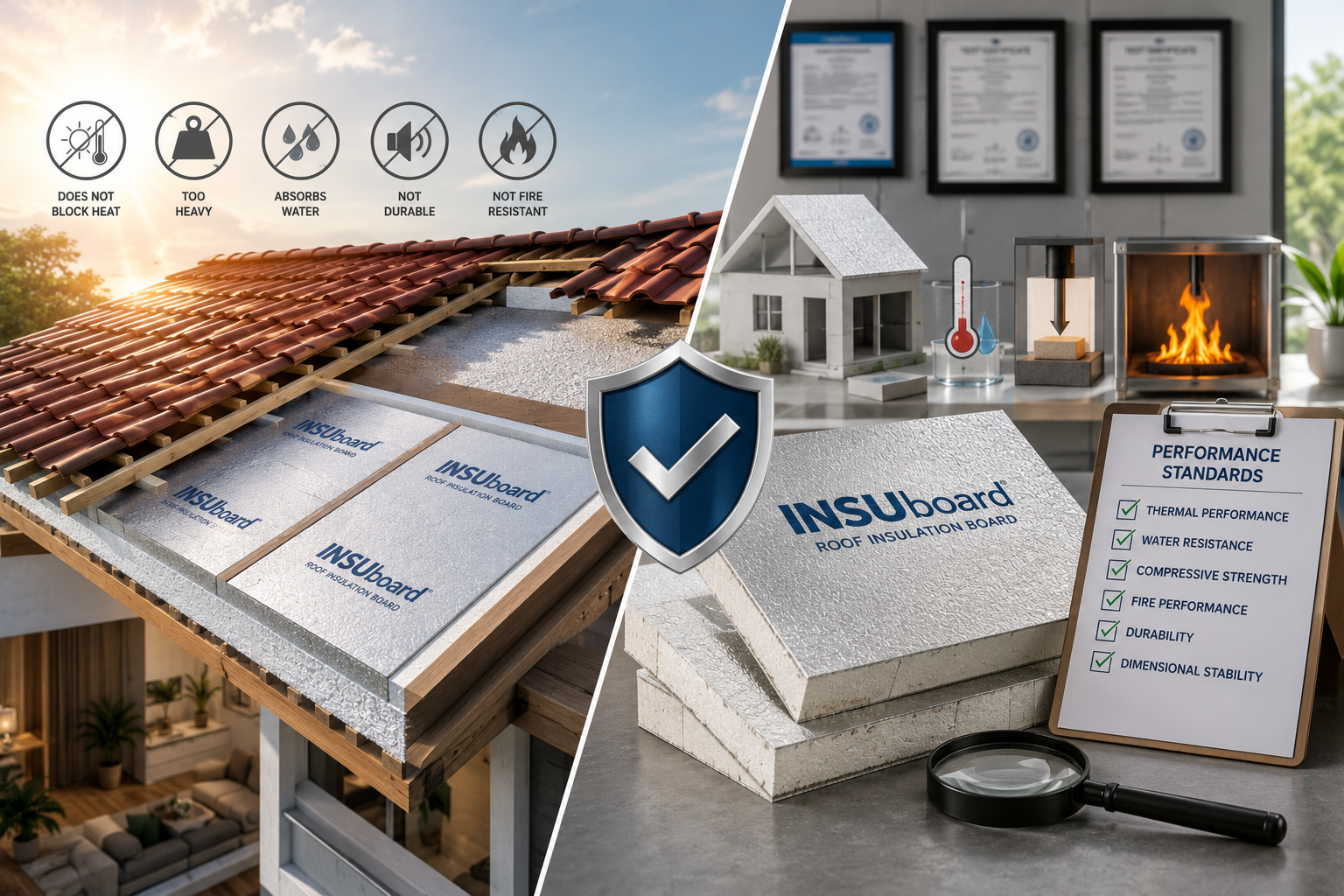
Misunderstandings about roof insulation are very common in India. Homeowners often postpone or ignore insulation options because they believe insulation boards are only useful in cold climates, that flat roofs don’t require them, or that the costs won’t merit the benefits. In a country where residential and commercial buildings account for about 30 percent of total electricity consumption and where that figure is expected to increase more than six times by 2047, according to NITI Aayog these myths are not only annoying but also costly. Poor thermal management in homes raises cooling costs, decreases comfort, and adds to the national energy burden.
In this blog, INSUboard, the thermal insulation brand of Supreme Petrochem Ltd, one of India’s top insulation companies, clarifies the most common myths about roof insulation. This guide covers whether insulation sheets really lower indoor temperatures, how inverted roof insulation works for flat roofs, and what performance standards mean in real life. It is based solely on verified product specifications and building science principles, giving Indian homeowners and builders a solid foundation for their insulation choices.
Myth 1: Roof Insulation Is Only Relevant in Cold Climates
This is the most common and likely the most harmful myth for Indian homeowners. Roof insulation is not just for keeping heat in; it also resists heat flow in both directions. In India’s mostly hot and humid climate, the main benefit is the opposite of what this myth claims: insulation slows the solar heat travelling through the roof into the living area below.
A concrete roof exposed to direct sunlight in cities like Nagpur, Ahmedabad, or Chennai can reach surface temperatures above 60°C. Without roof insulation, that heat moves through the slab into the ceiling and ultimately the room below, forcing air conditioning systems to work much harder. With proper over-deck or under-deck insulation using high-quality insulation sheets with a thermal conductivity (K value) of just 0.0289 W/m.K, like INSUboard’s Roof Grade XPS boards, the heat transfer rate is significantly lowered. This results in a noticeably cooler indoor environment even without air conditioning, and much lower energy costs when it is in use.
The payback period for correctly installed roof insulation in Indian homes usually averages around three years, after which the energy savings provide a net return on the investment for the life of the building. In the case of INSUboard, the insulation lasts as long as the building itself since it does not degrade or require replacement.
Myth 2: Flat Roofs Do Not Need Insulation — Inverted Roof Insulation Explained
Flat roofs are likely where roof insulation is most important in India, as they are the most common type in residential buildings and receive the highest solar load. A flat, uninsulated concrete roof acts like a heat collector, transferring energy directly into the top floor of a building throughout the day.
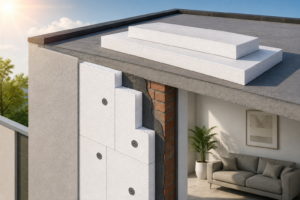
The inverted roof system is designed specifically for flat roofs and is among the most effective applications of over-deck insulation technology. In this system, the insulation layer goes above the waterproofing membrane, not below. This serves two purposes: it protects the waterproofing membrane from thermal cycling, UV damage, and physical harm, while also providing a barrier against external heat for the internal structure.
INSUboard’s Roof Grade XPS boards are made with features that suit an inverted roof system in India: minimal water absorption due to their closed-cell structure, a density greater than 34 kg/m³, compressive strength above 300 kPa (which makes them suitable for pedestrian and vehicle traffic), and a thermal conductivity of 0.0289 W/m.K These boards can be used for non-traffic flat roofs with gravel cover, pedestrian and vehicle traffic roofs with protection, roof gardens, and flat roof renovations. The inverted roof insulation setup using INSUboard boards also serves as a waterproofing protection board, providing two functions from a single material layer.
Myth 3: All Insulation Boards Perform the Same — The Truth About Thermal Efficiency Roofing
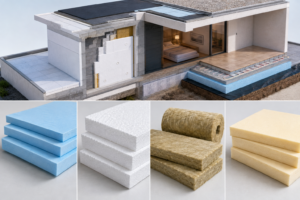
A major source of confusion among buyers is the mixing of different insulation materials. The two most commonly discussed in India are EPS (Expanded Polystyrene, known as Thermocol) and XPS (Extruded Polystyrene). These materials have different properties and performance levels, making it crucial to understand their differences to achieve better thermal efficiency in roofing.
EPS is made from expanded polystyrene beads that are fused under steam and pressure. This creates a structure with an open-cell characteristic, making it prone to water absorption over time. As water seeps into EPS over months and years, its insulation effectiveness declines. This is especially relevant during India’s monsoon season, when flat roofs are exposed to heavy, prolonged rainfall.
In contrast, XPS is produced by a continuous extrusion process that yields a uniform, fully enclosed closed-cell structure. This design means XPS has minimal water absorption, which it maintains for the building’s lifespan. INSUboard is an XPS product, not an EPS roof insulation board, and Supreme Petrochem Ltd highlights this distinction as a key performance factor. The closed-cell structure also gives INSUboard superior mechanical properties, including higher compressive strength and greater resistance to damage during installation and under load.
INSUboard’s thermal conductivity of 0.0289 W/m.K remains consistent across all uses and does not weaken with moisture exposure thanks to the closed-cell structure, which prevents water penetration. This long-term reliability makes XPS the preferred option for serious thermal efficiency roofing projects, unlike EPS roof insulation boards, which may lose effectiveness as water enters the open-cell structure over time.
Myth 4: Ceiling Insulation and Roof Insulation Are the Same Thing
These two terms are often used interchangeably, but they refer to distinct installation methods that yield different performance outcomes.
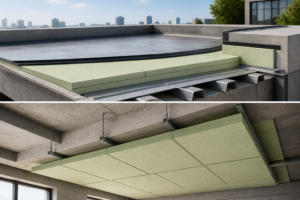
Roof insulation in the over-deck setup involves placing insulation boards on top of the structural roof slab above the waterproofing layer in an inverted roof system. This intercepts solar heat before it enters the building. Under-deck installation, on the other hand, places insulation boards below the roof slab on the underside facing the interior space. This setup functions as ceiling insulation, reducing the heat already in the structural slab from radiating into the room below.
Both methods have their uses and are included in INSUboard’s product range. For new construction, over-deck insulation is generally preferred because it protects both the structural slab and the waterproofing membrane. For existing buildings, under-deck ceiling insulation is a practical retrofit option. In both situations, INSUboard Roof Grade XPS boards offer the same basic performance: thermal conductivity of 0.0289 W/m.K and a density above 34 kg/m³.
INSUboard by Supreme Petrochem Ltd: What Sets It Apart as an Insulation Company in India
Supreme Petrochem Ltd (SPL) is a partnership between The Supreme Industries Ltd, the largest plastics processor in India, and R. Raheja Investments Pvt Ltd. Since starting its first plant in 1995, SPL has become the leading polystyrene manufacturer in India, with a market share of over 50 per cent and an annual production capacity of 272,000 TPA. The company exports its products to more than 100 countries.
In 2007, SPL launched India’s first integrated XPS insulation plant, which produces 100,000 m³ annually. With its INSUboard brand, SPL is the only company in India that makes XPS insulation boards locally. It uses environmentally friendly blowing agents and a fully automated, DCS-controlled continuous extrusion process. The plant technology was provided by Huntsman, a leading polystyrene manufacturer in the USA, and basic engineering consultancy was provided by ABB Lummus Crest.
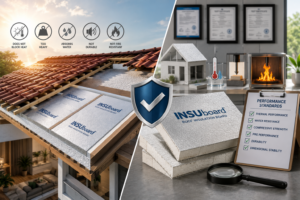
INSUboard has certifications from the Indian Green Building Council (IGBC), GRIHA (Green Rating for Integrated Habitat Assessment), NCCD (for cold storage applications), ISO 9001 (for quality management), ISO 14001 (for environmental management), and OHSAS 18001:2007 (for occupational health and safety). It is approved for under-deck, over-deck, and wall insulation under GRIHA rating systems, making it one of the most certified insulation products in India.
| Specification | Roof Grade | Wall Grade |
| Application | Overdeck & Underdeck | Cavity wall & EIFS |
| Thermal Conductivity (K Value) | 0.0289 W/m.K | 0.0289 W/m.K |
| Density | > 34 kg/m³ | > 34 kg/m³ |
| Compressive Strength | > 300 kPa | > 180 kPa |
| Water Absorption | Negligible (closed cell) | Negligible (closed cell) |
| Fire Retardancy | Self-extinguishing (DIN 4102 B2) | Self-extinguishing (DIN 4102 B2) |
| Expected Life | Life of the building | Life of the building |
INSUboard is not only used for roof and ceiling insulation; it also serves for wall insulation (cavity wall, external wall, EIFS), cold storage floors and ceilings, refrigerated vehicles, false ceilings, hydroponics applications, and vaccine packaging. This wide range of applications shows that the material performs consistently. The same closed-cell XPS structure that provides thermal efficiency for a residential flat roof also works in pharmaceutical cold chain applications.
What to Actually Check Before Choosing Roof Insulation Material
Given the many claims made by insulation companies in India, buyers need a clear set of criteria to assess products fairly. Here are the key performance parameters to consider:
Thermal Conductivity (K Value): Lower values indicate better insulation. INSUboard has a K value of 0.0289 W/m.K, one of the lowest for rigid insulation boards used in Indian buildings. Any insulation product should clearly display this value and reference a recognised testing standard.
Water Absorption: This aspect is crucial for Indian conditions. Insulation sheets with open-cell structures, such as EPS, absorb water over time, which degrades their performance. INSUboard’s closed-cell XPS structure has negligible water absorption, allowing the board to maintain its thermal performance during monsoon seasons.
Compressive Strength: This is important for roofs expected to have foot traffic, maintenance loads, or vehicle access. INSUboard’s Roof Grade has a compressive strength above 300 kPa, making it suitable for pedestrian and vehicular traffic roofs with proper protection.
Certifications: Look for GRIHA, IGBC, and ISO certifications. These provide third-party validation of the product’s environmental and performance standards, not just marketing claims.
Long-term durability: INSUboard is built to last for the life of the building with no need for replacement. Its closed-cell structure prevents water damage and structural creep under load.
Fire Retardancy: INSUboard includes flame-retardant additives to meet DIN 4102 Part 1 Class B2 standards. It is self-extinguishing when the external flame source is removed. Class B1 is also available for specific project needs.
Lastly, consider practical issues: can the insulation company maintain consistent quality, provide installation guidance, and support both new and retrofit projects? INSUboard works for over-deck and under-deck roof configurations, EIFS and cavity wall systems, along with ready-to-use INSUtile products for existing roofs. This makes it a reliable choice across various building types and renovation scenarios.
Myths about roof insulation persist due to a lack of understanding. The truth is clear: properly specified insulation with verified thermal conductivity, adequate compressive strength, and negligible water absorption can significantly reduce heat gain, cooling loads, and electricity bills. In Indian buildings, where roofs are a major source of solar heat gain, effective roof insulation is fundamental, not optional. INSUboard from Supreme Petrochem Ltd is the only XPS solution made in India, supported by the country’s only integrated XPS plant through the Supreme Industries Group.
Frequently Asked Questions
Yes, roof insulation acts as a barrier to the conductive transfer of heat between the hot roof surface and the living space below. INSUboard XPS boards have a thermal conductivity of 0.0289 W/m · K, which significantly reduces solar heat transmission. This results in cooler interiors, reduced air conditioning loads, and lower electricity bills. Energy savings usually offset the installation cost within about 3 years.
Flat roofs in India receive the most direct solar load of any building surface, so insulation is vital. An inverted roof system places insulation boards above the waterproofing membrane, which protects both the membrane and the structural slab from thermal cycling and UV damage. INSUboard Roof Grade XPS boards are specifically designed for this inverted roof system and are suitable for non-traffic roofs, pedestrian-access roofs, and roof gardens.
EPS (Expanded Polystyrene) has an open-cell structure that can absorb water over time, reducing insulation performance, especially during India’s monsoon. XPS (Extruded Polystyrene) has a uniform, closed-cell structure with minimal water absorption, ensuring stable thermal performance throughout the building’s life. INSUboard is an XPS product made at India’s only integrated XPS plant, operated by Supreme Petrochem Ltd.
Yes. INSUboard offers INSUtile, a ready-to-use insulation product that can be placed directly over an existing concrete flat roof without significant civil work. This makes retrofit insulation practical for buildings where full over-deck installation would be disruptive. For walls, the EIFS system allows INSUboard panels to be attached directly to existing wall surfaces, topped with a decorative finish.