India’s climate is harsh. Summer temperatures soar above 45°C in northern areas. Coastal humidity soaks walls for months, and urban heat islands make city living uncomfortable. Given these conditions, building insulation is now essential for homes, offices, schools, and factories across the country. This blog from INSUboard, produced by Supreme Petrochem Ltd, a leading insulation company in India, discusses the benefits of EPS insulation for roofs and walls. It explains why EPS roof insulation boards and wall insulation sheets are the preferred choice for architects, contractors, and building owners seeking long-term energy savings and occupant comfort.
Whether planning a new residential project, retrofitting an existing commercial building, or considering roof insulation for a high-rise, this guide outlines what EPS and XPS insulation are, how they get installed, why they work well in Indian conditions, and what makes INSUboard’s products unique. We will also examine the inverted roof system in the Indian context, a popular method for flat-roof buildings, and address common questions builders and homeowners have when deciding on insulation. According to NITI Aayog, residential and commercial buildings account for about 30% of India’s total electricity use; this figure is expected to grow more than sixfold by 2047. Properly insulated buildings can help lessen that load.
What Is EPS Building Insulation and How Is It Used in India?
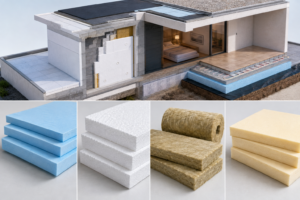
EPS stands for Expanded Polystyrene, a lightweight, rigid foam material made from polystyrene beads. These beads get expanded with steam and pressure, then fused into blocks from which insulation sheets of different thicknesses are cut. It is one of the most popular thermal insulation materials used globally and is gaining traction in India as awareness of energy efficiency grows.
XPS — Extruded Polystyrene is a related but technically superior type. Instead of bead moulding, XPS is produced by a continuous extrusion process, yielding a consistent, closed-cell foam structure. This closed-cell design is crucial because it prevents water absorption, maintains insulating properties throughout the life of a building, and ensures consistent compressive strength.
INSUboard, made by Supreme Petrochem Ltd, is an XPS insulation board, not EPS thermocol. This difference impacts performance. While EPS has its uses, XPS boards offer better thermal resistance, less water absorption, and greater compressive strength, making them well-suited to the challenges of Indian construction, including exposure to monsoons, heavy traffic, rooftops, and buildings that need to perform well for decades without maintenance.
Is EPS Insulation Suitable for Hot Climates? Why India’s Buildings Need Roof Insulation
A common question among Indian builders and homeowners is whether foam insulation boards work in tropical and semi-arid climates, where the goal is to keep heat out rather than in. The answer is a resounding yes. Thermal efficiency roofing solutions play a vital role in hot climates.
India’s flat-roofed buildings, especially concrete ones, act as thermal sponges. A bare concrete roof absorbs solar radiation during the day and releases stored heat into living and working spaces at night. Without roof insulation, air conditioning systems have to work harder and longer to maintain comfortable indoor temperatures, leading to higher electricity bills. With an effective EPS roof insulation board or XPS layer, the roof’s thermal mass is separated from the interior, significantly cutting down heat gain.
INSUboard has a thermal conductivity (K value) of just 0.0289 W/m.K, one of the lowest in the Indian market. Low K values mean less heat is transferred through the material, resulting in cooler interiors in summer and reduced heating needs in winter. INSUboard’s data shows that well-insulated buildings can greatly reduce the size and capacity of HVAC systems needed, cutting both initial and operating costs.
Roof Insulation and Ceiling Insulation: What Are Your Options with INSUboard?
INSUboard offers two main methods for roof insulation and ceiling insulation in Indian buildings, each suitable for different types of construction and project needs.
Over Deck Insulation (Inverted Roof System)
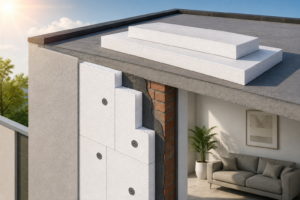
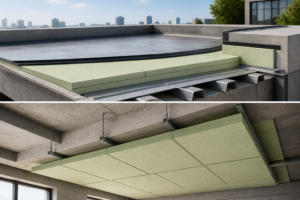
In an over-deck installation, INSUboard insulation sheets are placed above the waterproofing membrane on the roof deck. This setup is known as an inverted roof system. It is also called a “protected membrane” or “inverted warm roof” system. The main advantage is that the insulation layer protects the waterproofing from UV radiation, thermal cycling, and physical damage. This extends the life of the waterproofing layer and reduces long-term maintenance expenses.
The inverted roof system is especially relevant for flat-roofed residential and commercial buildings, where the roof is often used as a terrace or garden. INSUboard’s roof-grade boards can handle compressive strength greater than 300 kPa, making them suitable for pedestrian traffic, vehicular roof parks, and intensive roof gardens, not just for non-traffic applications. After waterproofing, the INSUboard is laid over the deck and finished with gravel, paving, or a screed layer, depending on its intended use.
Under Deck Insulation
Under-deck or under-deck ceiling insulation involves attaching INSUboard boards to the underside of the roof slab, either in new buildings or as a retrofit in existing ones. After installation, the boards are finished with a polymerised cement mortar for a smooth plaster surface, keeping the insulation hidden within the ceiling. This method is especially popular for retrofitting older buildings where disturbing the roof surface is challenging, and for situations where the primary goal is to reduce downward heat radiation from the roof into the spaces below.
Wall Insulation Methods: How INSUboard Insulation Sheets Improve Building Envelopes
India’s walls are often overlooked in building energy performance. Walls facing the sun absorb significant heat during peak summer months, making interiors uncomfortable and increasing cooling demands. INSUboard’s wall-grade insulation sheets address this challenge through three main methods:
• Cavity Wall Insulation: INSUboard boards get mechanically fixed to the external wall with screws and fasteners at each corner and in the middle of each board. An air gap of 25 mm is maintained, followed by the construction of an internal brick or AAC block wall to complete the cavity. Boards measuring 600 mm × 1,250 mm are used for easier handling on-site. This system provides permanent, maintenance-free insulation that is entirely protected within the wall structure.
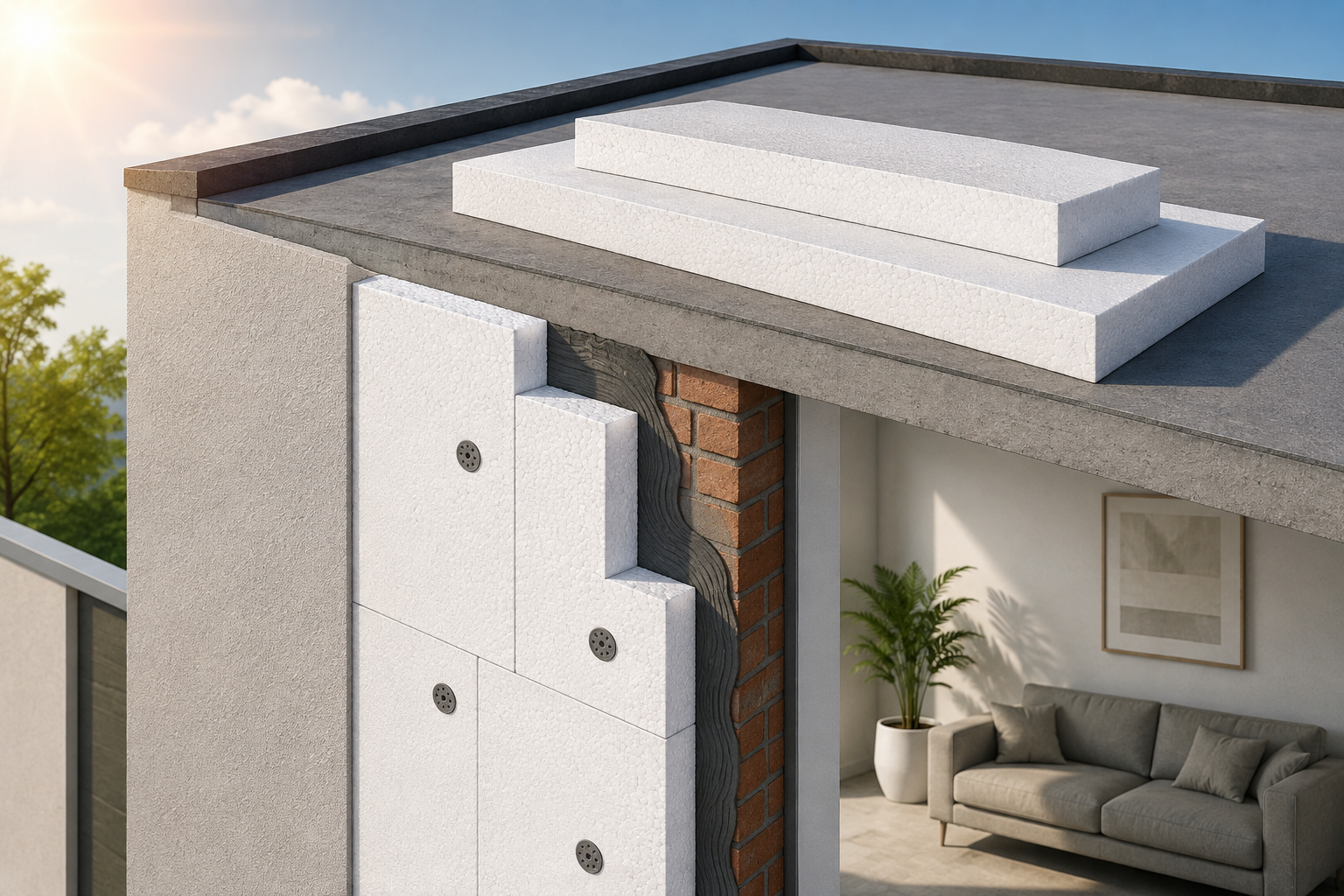
• External Wall Insulation: INSUboard is applied directly to the outer face of the wall, creating a continuous thermal barrier without thermal bridges through the wall. This works particularly well for retrofitting existing buildings.
• EIFS — Exterior Insulation and Finishing System: EIFS is a complete wall system where INSUboard is attached to the external wall and finished with a decorative render or textured coating. Supreme Petrochem has developed EIFS systems for Indian conditions, using either XPS or EPS boards as the insulation layer. The final surface looks like a standard rendered wall, while the insulation behind it maintains a stable interior temperature.
INSUboard’s wall-grade boards achieve the same thermal conductivity of 0.0289 W/m.K as their roof-grade counterparts, with a compressive strength above 180 kPa suitable for wall applications where loads are less intensive than on trafficked roofs. Their relatively high vapour diffusion resistance makes them effective in humid coastal and monsoon regions of India.
INSUboard by Supreme Petrochem: India’s Leading Insulation Company in This Sector
Supreme Petrochem Ltd, the parent company of INSUboard, has a unique position among insulation companies in India. Supreme Industries Ltd, the largest plastics processor in India, and the R. Raheja Group jointly promote it. The company runs India’s first and only integrated XPS insulation foam board plant, using eco-friendly blowing agents in a fully automated, DCS-controlled manufacturing process. The XPS plant has a capacity of 100,000 m³ per year.
As an insulation company in India with a real manufacturing base and not just a trading or importing operation, INSUboard provides dependable supply and consistent products that many competitors struggle to match. The company’s products are approved by GRIHA (Green Rating for Integrated Habitat Assessment) for underdeck, overdeck, and wall insulation applications, and are recognised by the Indian Green Building Council (IGBC). These certifications are important for green building projects and ECBC-compliant construction.
INSUboard’s product range goes beyond roofs and walls. It also includes cold-storage floors and ceilings, refrigerated vehicles, vaccine packaging, hydroponic applications, sandwich panels, and marine uses. This demonstrates the versatility of XPS as a material and Supreme Petrochem’s strong technical capabilities. Additionally, INSUboard offers INSUtiles, which are ready-to-use roof insulation tiles. These tiles can be placed directly over an existing concrete flat roof without requiring any civil work. This feature makes them perfect for quickly and cost-effectively retrofitting older buildings.
INSUboard XPS Technical Specifications — Roof and Wall Grades:
| Property | INSUboard — Roof Grade | INSUboard — Wall Grade |
| Application | Overdeck & Underdeck Insulation | Cavity Wall, External & EIFS |
| Thermal Conductivity (K Value) | 0.0289 W/m.K | 0.0289 W/m.K |
| Density | > 34 kg/m³ | > 34 kg/m³ |
| Compressive Strength | > 300 kPa | > 180 kPa |
Is EPS/XPS Insulation Fire-Resistant? Safety Considerations for Indian Construction
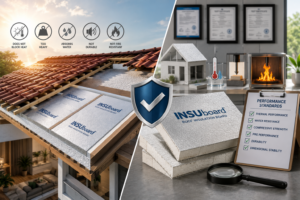
Fire resistance should be carefully considered when specifying foam insulation boards. INSUboard XPS is designed to be fire-retardant and self-extinguishing. When the source of ignition is removed, the material stops burning and does not spread flames. INSUboard meets DIN 4102, Part 1, Class B2 standards, and it also manufactures Class B1 grades for specific project needs.
Understanding the practical implications is vital. Like other organic building materials, such as timber, XPS can catch fire. However, it does not ignite on its own under normal building conditions; it requires direct flame contact. If exposed to a small flame, it self-extinguishes once the flame is removed, without continuing to burn. The combustion products from XPS polystyrene are not more toxic than those from common building materials like wood.
In practice, INSUboard is always installed beneath a protective covering in roof and wall applications, including screed, mortar, tiles, gravel, or render. This provides a physical barrier against direct flame exposure. This practice is standard and required by most building specifications, ensuring the insulation is shielded from UV radiation and fire risks.
How Is EPS Insulation Installed? A Practical Guide for Indian Builders and Contractors
One reason many Indian builders and contractors choose INSUboard is its simple and quick installation. The boards are lightweight, easy to cut on-site, and do not need specialised trades or complicated tools. INSUboard claims it is faster to install than any other insulation system. The company points out that well-insulated buildings reduce the size of HVAC systems needed, which eases both installation and capital costs for those systems.
For inverted roof insulation, the basic installation steps begin with preparing the roof after the waterproofing treatment, as recommended by the architect or consultant. Next, lay the INSUboard boards over the waterproofed deck and top them with the appropriate finish layer: gravel, paving slabs, screed, or a roof garden system, depending on the intended use. For cavity wall applications, boards are fixed to the external wall using screws and fasteners before constructing the internal wall. For EIFS, the boards are bonded or mechanically fastened to the outer face, then covered with a mesh-reinforced render system.
INSUboard comes in standard sizes of 600 mm × 1,250 mm for wall applications, making on-site handling, transportation, and installation easy without the need for heavy lifting equipment. Once installed in walls or on roofs, the boards require no maintenance and remain effective throughout the building’s life.
Frequently Asked Questions
EPS (Expanded Polystyrene) is made from polystyrene beads that are expanded and fused with steam, then cut into boards. XPS (Extruded Polystyrene) is made through a continuous extrusion process that creates a uniform closed-cell structure. The main practical differences include: XPS absorbs much less water due to its closed-cell structure, allowing it to maintain its insulating value in wet conditions; XPS usually offers higher compressive strength for a given thickness; and XPS delivers more consistent thermal performance over time. INSUboard is an XPS product. “Thermocol,” the common white foam used in packaging, is EPS and should not be confused with the structural insulation boards used in construction. (Source: insuboard.com/FAQs)
INSUboard XPS insulation boards have a thermal conductivity (K value) of 0.0289 W/m · K for roof, wall, and floor grades. This K value measures how easily heat passes through a material lower value indicates better insulation. At 0.0289 W/m.K, INSUboard ranks among the top thermal insulation materials in the Indian market. This figure is consistent across the product range, providing architects and engineers with a reliable value for thermal-efficiency calculations related to roofing and wall U-values. (Source: insuboard.com)
Once installed in walls or on roofs, INSUboard is designed to remain effective throughout the life of the building without requiring replacement. Its closed-cell structure does not absorb moisture, so it remains intact, unlike open-cell or fibre-based insulation materials. Regarding financial payback, INSUboard estimates that, for air-conditioned spaces, the average investment period is about 3 years. After that, energy savings provide a direct financial benefit for the building owner. For wall insulation, the thermal comfort can be significant even without air conditioning. Well-insulated walls may keep indoor temperatures low enough to eliminate the need for air conditioning in certain climates and seasons. (Source: insuboard.com/FAQs)
INSUboard is produced by Supreme Petrochem Ltd, one of the established insulation companies in India with a dedicated XPS manufacturing facility. As a leading insulation company operating nationally, INSUboard products are available through the company’s distribution network across India. Architects, contractors, builders, and project developers can contact the company directly through insuboard.com for product specifications, project consultation, and supply inquiries. Supreme Petrochem Ltd is headquartered at Solitaire Corporate Park, Andheri (East), Mumbai — 400093. The company serves customers in residential, commercial, industrial, and cold chain sectors.