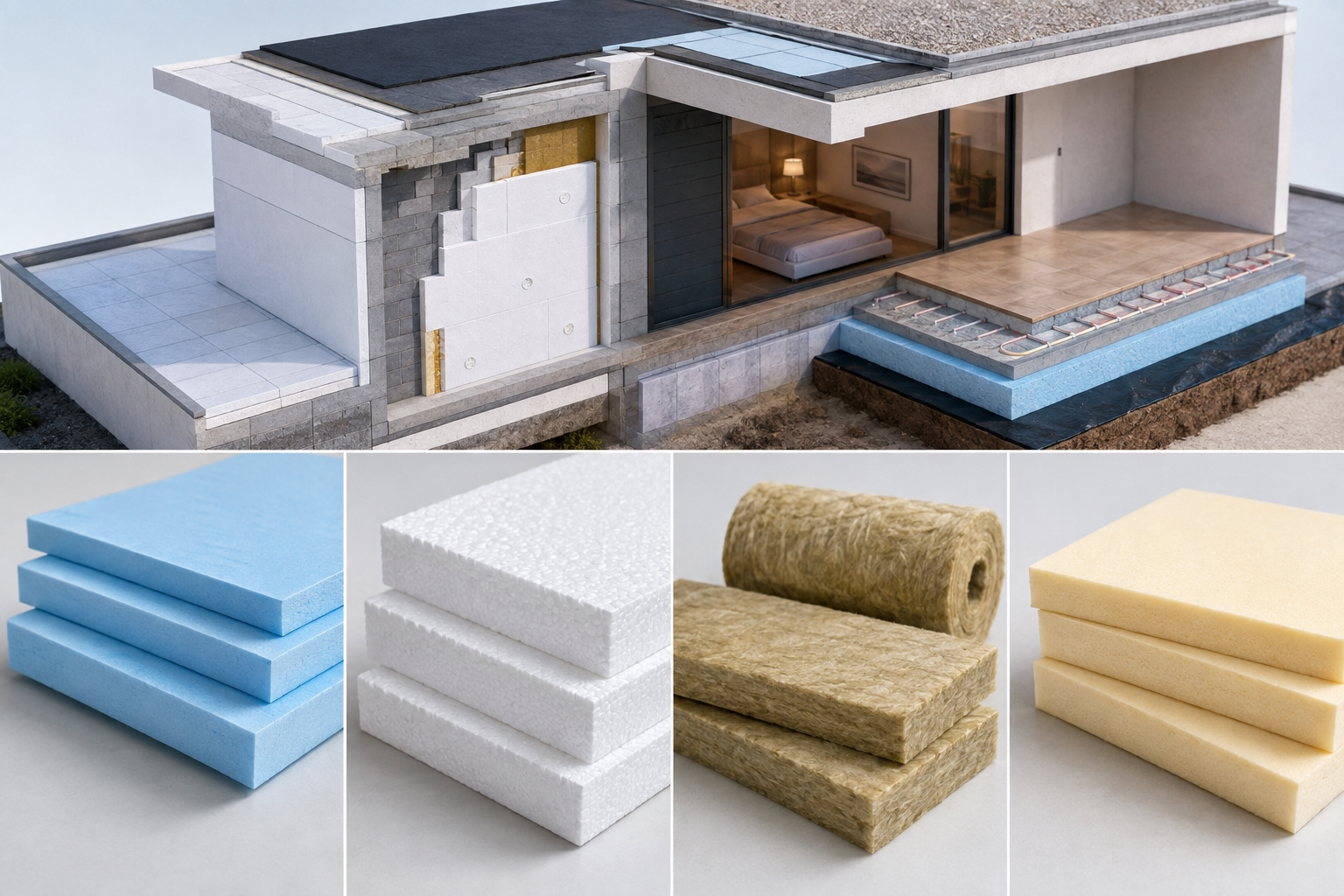
Selecting the right building insulation is one of the most important decisions you can make when designing or renovating a construction project, yet it is often overlooked. In India, where extreme summer heat, constant humidity, and increasing energy costs are common, the type and quality of insulation you choose greatly influence your building’s comfort, occupant energy costs, and long-term performance. In this blog, INSUboard from Supreme Petrochem Ltd, a reputable insulation company in India, outlines the main types of building insulation available today, explains how each type performs, and helps you determine which insulation material fits your specific project.
Whether you are specifying home insulation for a new residential build, choosing insulation sheets for a commercial setup, managing a large-scale ECBC-compliant development, or retrofitting thermal protection into an old structure, the options available in India are more diverse and effective than many people realise. This guide covers essential energy-efficient building materials in the insulation category, addresses common questions about R values, thermal conductivity, fire resistance, installation methods, and long-term durability, and explains why XPS-based solutions like INSUboard have become the top choice for discerning architects and contractors across India. According to NITI Aayog data cited by INSUboard, residential and commercial buildings account for about 30% of India’s total electricity consumption, a figure projected to grow more than sixfold by 2047. The insulation choices made today will significantly impact that trajectory.
What Is Building Insulation and Why Does It Matter in India?
Building insulation refers to any material that resists heat transfer between a structure’s interior and exterior. Heat moves in three ways: conduction, convection, and radiation, and effective insulation acts as a barrier against all three. In summer, insulation prevents solar heat from entering interior spaces. In winter or in air-conditioned areas, it prevents heat from escaping or cool air from escaping, reducing energy demand on HVAC systems.
In India, the main challenge is not heat loss but heat gain. A concrete flat-roofed building in Chennai, Rajasthan, or Mumbai without any roof insulation will absorb and radiate large amounts of solar energy during the day. Internal temperatures can exceed outdoor temperatures in these buildings, significantly increasing air conditioning demand and energy costs. Building insulation’s role is to separate the interior thermal environment from extreme outdoor conditions, creating a stable, comfortable, and energy-efficient indoor environment. Properly insulated buildings lower energy consumption, boost occupant comfort, and reduce carbon footprints, all of which support India’s broader energy and sustainability goals under ECBC (Energy Conservation Building Code) guidelines.
What Are the Different Types of Building Insulation Available in India?
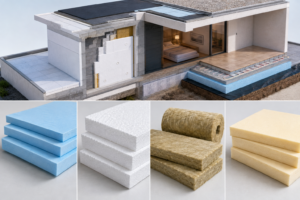
India’s construction market now offers a wider range of insulation materials than ever before. Knowing the key types and their strengths and limitations is crucial for making informed choices.
Extruded Polystyrene (XPS) — Rigid Foam Boards
XPS is made through a continuous extrusion process that produces a homogeneous, closed-cell foam structure. This closed-cell design is vital because the foam’s individual cells are completely sealed, preventing water from entering. The practical outcomes are substantial: XPS does not absorb moisture, retains its insulation properties for the building’s lifespan, and provides consistent compressive strength.
INSUboard, manufactured by Supreme Petrochem Ltd, is an XPS product. It achieves a thermal conductivity (K value) of 0.0289 W/m.K, one of the lowest in India, and is made in an automated, DCS-controlled facility using eco-friendly blowing agents. INSUboard comes in roof, wall, and floor grades, each designed for specific load and performance needs. It is the preferred EPS building insulation solution in India for projects requiring long-term reliability without maintenance. (Source: insuboard.com/FAQs; insuboard.com)
Expanded Polystyrene (EPS) — Foam Boards and Beads
EPS is the more commonly known foam material, often referred to as “thermocol” in India. It is made by expanding polystyrene beads with steam and pressure, which fuse them into blocks from which insulation sheets are cut. EPS offers decent thermal performance at a lower cost than XPS. Still, its open-cell structure means it absorbs more moisture over time, which can diminish its insulating ability in wet or humid conditions. For basic dry applications, EPS boards work sufficiently. For roofs, below-grade purposes, cold storage, or any area with moisture exposure, XPS is the superior choice. Supreme Petrochem Ltd is also the largest producer of EPS raw materials in India, positioning INSUboard to offer expertise across both types.
Rockwool and Glasswool — Mineral Fibre Insulation
Mineral wool products like Rockwool and Glasswool are fibrous insulation materials made from natural rock or recycled glass, spun into fine fibres and formed into blankets, batts, or rigid boards. They are commonly used for acoustic insulation, fire-rated walls, and HVAC duct wrapping. However, mineral wools absorb moisture easily, which can compress fibres and weaken thermal performance over time. They are less suitable for exposed roofs or external walls in India’s monsoon climate without extra moisture protection, and handling them requires protective gear due to fibre irritation.
Polyurethane (PUR) and Polyisocyanurate (PIR) Foam
PUR and PIR are spray-applied or rigid-board insulation materials with very low thermal conductivity, typically lower than XPS, and excellent adhesive qualities. They are commonly used in sandwich panels, refrigerated vehicle bodies, and specialised industrial cold chain applications. PUR/PIR can cost more than XPS and needs careful installation by trained professionals. For average residential and commercial building applications in India, XPS boards offer a more practical, cost-effective solution with comparable long-term performance.
Key Insulation Material Comparison:
| Material | K Value (W/m.K) | Water Absorption | Best Application |
| XPS (INSUboard) | 0.0289 | Very low (closed cell) | Roofs, walls, floors, and cold storage |
| EPS (Thermocol boards) | Higher than XPS | Low–moderate | Basic insulation, packaging |
| Rockwool / Glasswool | Moderate | Can absorb moisture | Acoustic insulation, HVAC ducts |
| PUR / PIR foam | Very low | Very low | Sandwich panels, refrigeration |
What Is the R Value of Building Insulation and Why Does It Matter?
Two key values guide building insulation specifications: the K value (thermal conductivity) and the R value (thermal resistance). They are inversely related; the lower the K value, the higher the R value for a given thickness, meaning better insulation performance.
The K value indicates how readily heat flows through 1 meter of material. The INSUboard XPS has a K value of 0.0289 W/m · K. The R value is calculated by dividing the material’s thickness by its K value. A thicker board or one with a lower K value results in a higher R value and greater heat flow resistance.
For building specifiers and architects working on ECBC-compliant projects or aiming for GRIHA and IGBC green building ratings, these values are essential for U-value calculations for walls, roofs, and floors. INSUboard’s consistent K value across its product line gives designers a reliable number for these calculations. For best results, INSUboard recommends installing insulation on all exterior walls and the roof; at a minimum, sun-facing walls and roofs should be prioritised.
How Is Building Insulation Installed in Walls and Roofs in India?
Installation methods vary based on the material, building element, and whether the project is new construction or a retrofit. INSUboard offers a range of installation systems for the Indian construction market, each tailored to real site conditions and practical handling constraints.
Overdeck Roof Insulation
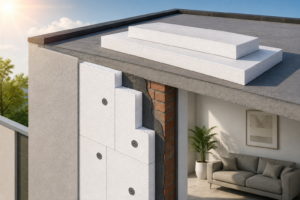
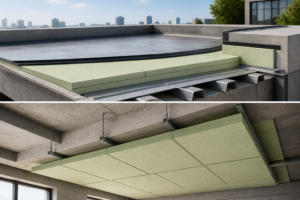
In an overdeck application, insulation sheets are placed above the waterproofing membrane on the roof slab, acting as both a protective and insulating layer. The boards protect the waterproofing from UV radiation and thermal cycling, significantly extending its service life. The roof surface is then finished with gravel, paving, screed, or a roof garden system based on its intended use. INSUboard’s roof-grade boards achieve a compressive strength above 300 kPa, making them suitable for pedestrian traffic, vehicle access roofs, and intensive roof gardens.
Underdeck Ceiling Insulation
Underdeck or ceiling insulation involves installing INSUboard boards beneath the roof slab. This can happen during new construction or as a retrofit. Once in place, the boards are covered with polymerised cement mortar for a plaster-like finish, ensuring the insulation remains hidden within the final ceiling. This method works well for retrofitting without disturbing the roof surface.
Cavity Wall, External Wall, and EIFS Insulation
For wall applications, INSUboard offers three main systems. In cavity wall installations, boards are attached to the outer brick or concrete wall using screws and fasteners, leaving a 25 mm air gap before constructing the inner wall. The standard board size is 600 mm × 1,250 mm for easier handling on site.
EIFS – Exterior Insulation and Finishing System – provides a complete wall solution in which INSUboard XPS is bonded and fixed to the exterior wall face. It is reinforced with a glass fibre mesh embedded in adhesive mortar and finished with texture paint, skim coat, or emulsion. The EIFS method developed by Supreme Petrochem is specifically designed for Indian weather conditions and can be used on both new construction and existing facades. The result is a weatherproofed, thermally insulated, and aesthetically pleasing exterior wall that requires no ongoing maintenance.
INSUboard by Supreme Petrochem: A Leading Insulation Company in India
When evaluating insulation companies in India, the strength and reliability of their manufacturing base are just as important as their product specifications. INSUboard is made by Supreme Petrochem Ltd, which is jointly promoted by The Supreme Industries Ltd, India’s largest plastics processor, and the R. Raheja Group. Supreme Petrochem operates India’s first integrated XPS insulation foam board plant, established in 2007 and with an annual production capacity of 100,000 m³. The plant uses eco-friendly blowing agents in a fully automated process that meets international standards.
As a committed insulation company in India with real manufacturing capabilities, INSUboard does not depend on imports or third-party supply chains. This ensures consistent supply, product traceability, and the ability to meet project-specific needs through direct technical consultation. The company’s certifications show its credibility: INSUboard has GreenPro certification, is approved by GRIHA for underdeck, overdeck, and wall insulation, is recognised by NCCD for cold storage applications, and is a member of the Indian Green Building Council (IGBC). It also has ISO 9001, ISO 14001, and OHSAS 18001 quality and safety management certifications.
In addition to roofs and walls, INSUboard’s products include cold storage floors and ceilings, refrigerated vehicles, vaccine packaging, temperature-sensitive pharmaceutical transport, sandwich panels, marine applications, and hydroponics. The company also offers INSUtiles, which are ready-to-use roof insulation tiles. These tiles can be placed directly on existing flat concrete roofs without any construction work, making them an ideal retrofit solution for residential and commercial buildings looking to improve insulation quickly and affordably.
Does Building Insulation Work in Hot and Humid Climates? The India-Specific Case
This is one of the most common questions INSUboard receives from Indian clients. The answer is yes. In fact, building insulation may be even more beneficial in hot climates than in cold ones. The science is simple: a high-thermal-resistance barrier keeps heat out just as effectively as it keeps warmth in. In India, the temperature difference between an unshaded concrete roof and a comfortable interior temperature in peak summer can exceed 30°C, which is much larger than the typical heating difference in a mild European winter.
XPS insulation performs especially well in hot and humid conditions due to its closed-cell structure, which resists moisture absorption. In humid coastal areas like Mumbai, Chennai, and Kochi or during the monsoon season, materials that absorb water will gradually lose thermal performance as moisture fills the spaces that once held air. INSUboard’s low water absorption rate keeps its K value, 0.0289 W/m.K, stable throughout the monsoon and beyond.
For sun-facing walls and flat roofs, INSUboard recommends its application as a baseline. The payback period for energy-efficient building materials, such as XPS insulation, is about 3 years in air-conditioned spaces. After that, the energy savings lead to direct financial returns. In many Indian climates, wall insulation can greatly improve thermal comfort even without air conditioning.
Is Building Insulation Mandatory for Construction in India?
India’s Energy Conservation Building Code (ECBC) establishes thermal performance standards for commercial buildings with a specific connected load threshold, with the Bureau of Energy Efficiency (BEE) overseeing compliance. The ECBC outlines minimum U-values for roofs, walls, and glazing, effectively requiring insulation in covered buildings. Residential buildings are facing increasingly similar requirements under the Eco Niwas Samhita (ENS), which establishes energy efficiency standards for multi-family housing.
For projects seeking GRIHA ratings, IGBC green building certification, or GreenPro compliance, insulation is not just recommended but is a required factor that affects energy performance credits. INSUboard’s GRIHA and IGBC approvals make it an easy choice for project teams pursuing these ratings. Even where compliance is not required, the operational and financial benefits of EPS building insulation in India are strong: reduced HVAC system sizing, lower energy bills, improved occupant comfort, and a smaller carbon footprint over the building’s lifespan.
Frequently Asked Questions
Given India’s predominantly hot and humid climate, XPS (Extruded Polystyrene) rigid foam boards, such as INSUboard, are considered the best insulation solution. The closed-cell structure of XPS ensures minimal water absorption, protecting it from moisture that can affect the performance of EPS, mineral wool, and other materials during and after the monsoon. XPS also has high compressive strength for roof applications, long-term thermal stability, and is compatible with all standard installation methods used in Indian construction, including cavity wall, EIFS, overdeck, underdeck, and cold storage. INSUboard achieves a K-value of 0.0289 W/m · K and is designed specifically for Indian building conditions. (Source: insuboard.com/FAQs)
The process is straightforward: insulation slows heat transfer through walls, roofs, and floors. In a well-insulated building, air conditioning systems do not have to work as hard or for as long to maintain a steady indoor temperature because less heat enters from outside. This results in lower electricity consumption. Well-insulated buildings also require smaller HVAC systems, reducing both capital costs and operating expenses. Data from INSUboard indicates the average payback period for insulation investment in air-conditioned spaces is about three years, making it one of the best energy-efficient building materials for owners.
XPS insulation boards, such as INSUboard, are designed to last the entire lifespan of the building, typically 30 to 50 years or more. Once installed in walls or on a roof, they do not need replacement or maintenance. The closed-cell structure of XPS prevents moisture absorption, compression over time, and loss of thermal properties due to wear. On the other hand, mineral wool products can compress and absorb moisture over time, while EPS boards may offer lower long-term stability in wet conditions. For projects where the insulation must remain effective throughout the building’s lifecycle without intervention, XPS is the most dependable choice.
Thermal and acoustic insulation deal with different physical issues, though some materials work for both. Thermal insulation slows heat transfer, and the K-value and the R-value measure its efficiency. Acoustic insulation reduces sound transmission, and its effectiveness is measured by metrics like sound transmission class (STC) and sound absorption coefficient. Mineral wool products, such as Rockwool and Glasswool, are especially effective for acoustic insulation due to their fibrous, porous structure, which absorbs sound energy. XPS and EPS rigid foam boards primarily serve as thermal insulators and offer limited acoustic benefits on their own. Still, they can be combined with acoustic layers in composite wall systems. When selecting insulation for homes or commercial buildings, it’s important to understand whether thermal, acoustic, or both challenges are the main concern to choose the right material.