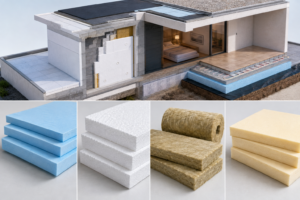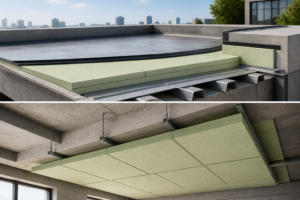
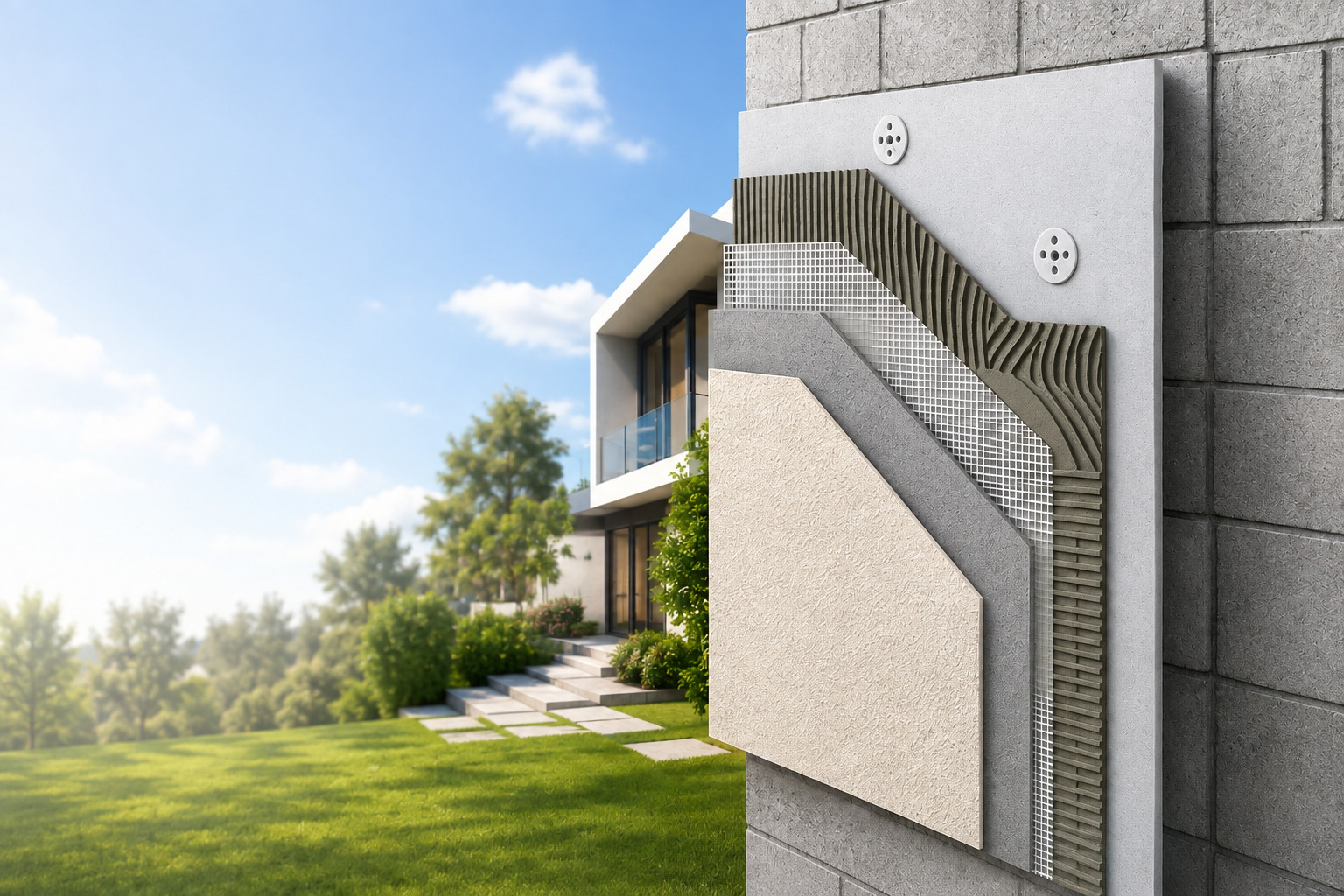
Integrating INSUboard into external wall insulation systems transforms building envelopes by providing superior thermal performance, moisture resistance, and crack protection for plastered walls, making it suitable for India’s diverse climates. As a high-strength extruded polystyrene (XPS) solution, INSUboard ensures energy savings up to 30% in residential and commercial spaces while extending structural longevity (BEE India, 2025).
Supreme Petrochem, a leader among insulation companies in India, guides you through seamless INSUboard integration for EIFS, based on our advanced XPS production. This blog covers preparation, installation steps, best practices, and real-world applications to help architects and builders achieve net-zero-ready facades.
What Is INSUboard, and Why Should You Choose It for Wall Insulation?
INSUboard, Supreme Petrochem’s flagship wall insulation material, is an extruded polystyrene (XPS) rigid foam board with a closed-cell structure, having a thermal conductivity of 0.0289 W/m·K and compressive strengths ranging from 180 to 500 kPa depending on grade. Unlike expanded polystyrene (EPS), INSUboard resists water absorption, maintaining long-term R-values even in humid monsoon conditions, making it ideal for external wall insulation where resilience is essential to performance.
For EIFS, INSUboard’s ship-lap edges create staggered, airtight joints that prevent thermal bridges. As an insulation company in India, leader Supreme uses eco-friendly blowing agents that align with green building standards such as IGBC and GRIHA.
Key Specs Table:
| Grade/Application | Density (kg/m³) | Compressive Strength (kPa) | Ideal Use |
| Cavity Wall & EIFS | >34 | >180 | Facades, partitions |
| Overdeck/Underdeck | >34 | >300 | Roofs |
| Flooring | >38 | >500 | Heavy-load slabs |
This versatility fills gaps in Indian EIFS guides, which often overlook XPS’s superior moisture resistance compared to mineral wool.
Advantages of INSUboard in External Wall Insulation Systems
External wall insulation with INSUboard reduces heat ingress in Mumbai’s tropical climate, stabilising indoor temperatures and lowering air-conditioning demand—crucial, as buildings account for 30% of India’s electricity consumption (NITI Aayog, 2024). Its high compressive strength protects against plaster cracks caused by structural settlement or seismic activity, extending the facade’s lifespan by decades.
Moisture management sets INSUboard apart: closed cells prevent capillary action, unlike fibrous insulation material prone to mould in coastal areas.
Preparing Surfaces for INSUboard EIFS Integration
Success depends on substrate readiness. Begin by levelling and plastering walls to <5mm deviation, then wire-brush to clear dust, efflorescence, or oils; repair cracks with polymer mortar.
Prime with a rubberised asphaltic emulsion (500g/m²), a solvent-free, water-based barrier that cures in 6 hours and improves adhesion in humid areas. Test the moisture content (<12%) to prevent trapped vapour from forming bubbles.
Pro Tip: In Seismic Zone III+ areas such as Mumbai, add alkali-resistant fibreglass mesh before plastering to reinforce the substrate.
Step-by-Step Guide: Installing INSUboard in EIFS
Follow this proven methodology for :
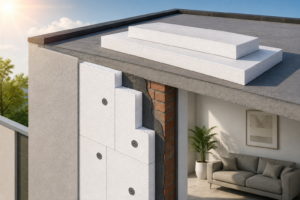
- Board Placement: Cut INSUboard to fit in a staggered ship-lap pattern, with interlocking edges for seamless coverage. Orient vertically for multi-storey facades.
- Mechanical Fixing: Drill pilot holes and secure with PVC fasteners (5 per board: 4 at the corners, 1 at the centre). Use 50mm diameter PVC discs; fastener length = board thickness plus 30-40mm into the substrate. Torque to 10-15 Nm to compress without crushing cells.
- Adhesive Alternative: For low-rise, spot-apply solvent-free polyurethane adhesive (20-30 spots per board), press firmly for 10% contact.
- Base Coat & Mesh: Embed alkali-resistant fibreglass mesh (160g/m²) in 2-3mm polymer-modified base coat over INSUboard. Overlap seams by 100mm; feather edges.
- Finish Layers: Apply textured acrylic finish (1-2mm) or stone cladding/ACP panels on framework. Seal penetrations with silicone.
Timeline: prep (1 day), boards (1-2 days), coats (2-3 days), finish (3-5 days) for 1,000 sqm façade.
Mechanical vs Adhesive Fixing: Which Is Best for Your Project?
Comparison Table:
| Method | Pros | Cons | Best For |
| Mechanical | Superior shear strength; seismic-proof | Higher labour; visible plugs | High-rises, coastal |
| Adhesive | Seamless aesthetics; faster | Weaker in peel; temp-sensitive | Low-rise, dry climates |
Mechanical systems dominate Indian EIFS for cyclone-prone coasts; adhesives are suitable for retrofits.
Integrating INSUboard with Finish Systems
Post-insulation, pair INSUboard with aesthetic claddings such as stone panels (10-20mm ventilated gaps), ACP sheets, or cement boards on aluminium frames for a rainscreen effect. This hybrid enhances vapour permeability, preventing interstitial condensation.
For textured finishes, use silicone-reinforced renders compliant with IS 15499:2020.
Spotlight on Supreme INSUboard: India’s Leading XPS Provider
Supreme Petrochem Ltd, the only insulation company in India operating an eco-friendly XPS plant, produces INSUboard at Nagothane using HFC-free blowing agents for zero ODP and GWP. As Asia’s largest EPS manufacturer, we vertically integrate to ensure consistent quality—wall insulation grades designed for EIFS with a density exceeding 34 kg/m³.
Our INSUboard holds IGBC certification, with grades for cavity walls (180 kPa) to flooring (500 kPa). Technical support includes site audits and BIM models for accurate integration.
Common Mistakes to Avoid in INSUboard EIFS Installation
Overlooking expansion joints results in 40% of cracks—spacing them 5-7m apart and filling with silicone. Insufficient priming causes debonding; always check the emulsion cure with the thumb test.
Avoid mesh overlaps to prevent micro-cracks; professionals use laser levels to ensure planarity within <3mm/2m. During retrofits, check substrate alkalinity (<10 pH) to avoid foam degradation.
Checklist:
- Verify board compressive strength matches loads
- Conduct pull-off tests (>0.8 MPa)
- Monitor ambient temp (5-35°C during install)
- Document with thermography post-finish
Testing and Quality Assurance for Sustained Long-Term Performance
Post-installation, hygrothermal simulations predict dew points; INSUboard’s λ = 0.0289 ensures there is no condensation risk. Field tests: thermography for gaps; blower door for airtightness (<3 ACH50).
Comply with IS 16716 (XPS) and ASTM C578 Class C/D.
Cost-Benefit Analysis: INSUboard EIFS vs Traditional Methods
Initial cost: ₹150-250/sqm for INSUboard EIFS compared to ₹100/sqm for plaster—reach break-even in 3-5 years through 30% energy savings (TERI Study, 2024). Lifecycle savings include 50% lower maintenance costs and no need for repainting every 5 years.
ROI boosters: ECBC rebates, higher rentals (10-15% premium for green buildings).
In conclusion, mastering INSUboard integration with external wall insulation enables builders to create resilient, energy-efficient facades that withstand Indian monsoons and heatwaves. Supreme Petrochem’s innovation closes performance gaps, ensuring your projects lead in sustainability and comfort.
Frequently Asked Questions
Mechanical PVC fasteners (5 per board) ensure seismic stability; adhesives are suitable for low-rise applications. Stagger ship-lap joints to ensure airtightness, in accordance with Supreme guidelines.
Yes, <0.5% water absorption maintains R-value, and closed-cell foams prevent mould growth, unlike open-cell foams. Ideal for coastal EIFS.
50-75mm for U<0.4 W/m²K in composites; custom per climate zone. Consult Supreme for ECBC compliance.
Absolutely—spot adhesive or anchors work on plastered walls. Boosts energy efficiency 25-40% without interior disruption.