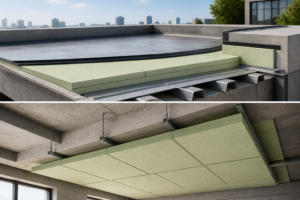
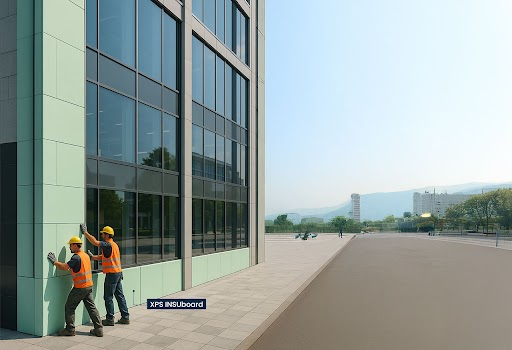
INSUboard Wall Grade emerges as a premier insulation solution, engineered for superior thermal performance in commercial buildings facing extreme heat loads. This extruded polystyrene (XPS) board delivers unmatched durability, moisture resistance, and energy savings critical for offices, shopping centres, and warehouses.
This blog from Supreme Petrochem examines INSUboard Wall Grade as a cutting-edge wall insulation, outlining its role in building insulation. Discover applications, benefits, installation methods, and comparisons that show why it’s the preferred insulation material from the leading insulation company in India.
Understanding INSUboard Wall Grade Fundamentals
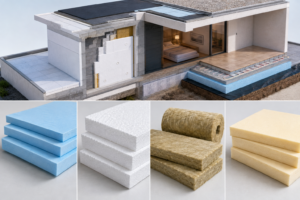
INSUboard Wall Grade, a rigid XPS foam board from Supreme Petrochem, features a closed-cell structure that minimises heat transfer through conduction, convection, and radiation. With low thermal conductivity (0.0289 (W/m.K), it outperforms traditional materials, reducing indoor temperatures by up to 10°C during Indian summers. Lightweight (34 Kg/ m3 density) yet high in compressive strength (> 300 kPa), it is ideal for wall insulation in multi-storey commercial buildings. Zero ODP/GWP blowing agents ensure environmental compliance; negligible water absorption (<0.3%) maintains its R-value for life. This home insulation variant adapts seamlessly to a range of building insulation needs.
Why Wall Insulation Matters for Commercial Structures
Commercial buildings lose 30-35% of cooling energy through uninsulated walls, according to Bureau of Energy Efficiency data, resulting in avoidable AC costs of ₹ billions. INSUboard Wall Grade reduces this loss by 40-50%, allowing for smaller HVAC systems and achieving a 3-year payback period. Besides saving costs, it helps mitigate urban heat islands, improves occupant comfort, and meets ECBC Grade A office norms. Insulation sheets like INSUboard also prevent condensation and extend wall lifespans. In humid Mumbai warehouses, moisture-proofing prevents mould, ensuring hygienic spaces essential for retail and malls. Strategic insulation investments generate ROI and support sustainability.
Spotlight on Supreme Petrochem’s INSUboard Excellence
Supreme Petrochem, the leading insulation company in India, manufactures INSUboard through continuous extrusion at its world-class Nagothane facilities—producing over 1,50,000 m³ annually. INSUboard Wall Grade holds certifications such as ISO 9001, GRIHA, and IGBC, offering flame-retardant options (Class B2/B1) and versatility for EIFS, cavity walls, and internal/external applications. Thicknesses range from 25 to 100 mm to meet R-values of 1-4 m²K/W; custom high-density grades are suitable for seismic zones. Unlike EPS, closed-cell structures retain their properties indefinitely. With over 20 years of XPS expertise, Supreme supplies insulation sheets for landmarks such as Mumbai malls, demonstrating its reliability in building insulation.
Key Uses of Insulation Sheets in Walls
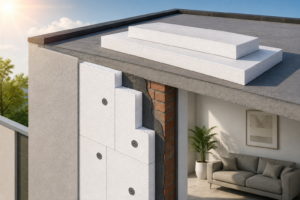
INSUboard Wall Grade excels in External Insulation Finishing Systems (EIFS), glueing directly to facades for seamless thermal barriers. Cavity walls sandwich boards between masonry, bridging gaps; internal retrofits clad partitions without disrupting operations. Commercial malls use 50mm sheets, reducing air conditioning loads by 25%; offices achieve LEED credits through wall insulation. Cold storage facilities pair with Floor Grade for integrated envelopes. Roof insulation materials complement walls in PEBs, but Wall Grade’s vapour resistance uniquely suits facades. Versatile fixing methods—adhesives, fasteners—are suitable for concrete or brick substrates.
Thermal Performance and Energy Conservation Overview
INSUboard‘s R-value consistency reduces heat ingress compared to rockwool, according to lab tests, helping cut peak loads. Insulation material prevents thermal bridging at junctions, ensuring uniform temperatures. In air-conditioning-dependent commercial buildings, smaller chillers (20% capacity reduction) reduce capital expenditure. Building insulation with INSUboard supports India’s net-zero targets, cutting CO₂ emissions by 1-2 tonnes per building annually. Simulations confirm summer comfort without drafts and winter warmth retention.
Comparing INSUboard to Other Insulation Materials
| Property | INSUboard Wall Grade | Rockwool/GF | EPS/PUR Foam | Polyurethane Spray |
| Thermal Conductivity | 0.028 W/mK | 0.035-0.040 | 0.032-0.038 | 0.022-0.028 |
| Water Absorption | <0.3% (vol) | 1-5% | 2-4% | <1% |
| Compressive Strength | 200-350 kPa | 50-100 kPa | 100-150 kPa | Low (foam) |
| Installation Speed | High (sheets) | Medium (batts) | Low (beads) | Pro-only |
| Cost (₹/sqm, 50mm) | 250-350 | 300-450 | 200-300 | 400-600 |
| Lifespan | 50+ years | 20-30 | 20-30 | 25-40 |
INSUboard gaps: superior moisture control and wall compression.
Sustainability and Compliance Benefits
Supreme, the leading insulation company in India, supports green certifications such as LEED and IGBC for commercial projects. Low-embodied energy (120 MJ/m³) surpasses mineral wools. Wall insulation lowers urban emissions by 20-30%, and its durability minimises replacements. In net-zero initiatives, INSUboard facilitates passive design, significantly reducing operational carbon emissions. Ethical sourcing of polystyrene promotes a circular economy in building insulation.
Maintenance and Longevity Insights
INSUboard requires minimal maintenance—resistant to pests and mould, UV-stable when beneath plasters. Inspect finishes annually; seal cracks promptly. Designed for a 50-year lifespan per ASTM; unlike open-cell foams, it does not degrade. Roof insulation materials are suitable for envelopes, but walls in air-conditioned zones need vapour barriers. Supreme guarantees performance; thermography confirms integrity. When retrofitting internal spaces, peel off old plaster and reuse boards. Its low lifecycle cost (₹0.5/sq.m/year) supports the return on investment for building insulation. Proactive monitoring maintains efficiency in demanding commercial environments.
Future Trends in Wall Insulation
Smart insulation materials with embedded sensors monitor R-values; phase-change integration enhances peak performance. Supreme Industries Limited commits to reaching net-zero greenhouse gas emissions across the value chain by FY2050. Aerogels hybridise for ultra-thin home insulation, but INSUboard’s cost-strength ratio wins in commercial markets. Policy supports: MTSA mandates building insulation in new constructions. Digital twins optimise placement strategies. Insulation companies in India, like Supreme, pioneer FR graphene additives. Modular panels accelerate large-scale projects; wall insulation becomes integrated into BIM workflows.
INSUboard Wall Grade redefines insulation for commercial buildings, providing long-lasting thermal barriers that conserve energy, improve comfort, and support sustainability. Supreme Petrochem‘s innovation helps builders efficiently future-proof structures.
Frequently Asked Questions
Its light weight, relatively high vapour diffusion resistance, higher thermal resistance, and ease of handling make it the most preferred and best-suited solution for wall insulation.
INSUboard helps save energy in commercial buildings by forming a strong thermal barrier, greatly reducing heat transfer through walls, roofs, and floors. This lessens the workload on HVAC systems for heating and cooling, resulting in lower energy use, decreased utility bills, and a smaller carbon footprint.
Yes, INSUboard is highly suitable for Exterior Insulation and Finishing Systems (EIFS) in building insulation. It is an ideal solution for EIFS, as well as external and internal wall, roof, and floor insulation.
The suitable thickness for insulation sheets in an office depends on the application (roof, wall, or floor), the material used, and local building energy regulations. Generally, for modern, energy-efficient offices, 50mm to 150mm+ is common for rigid boards.