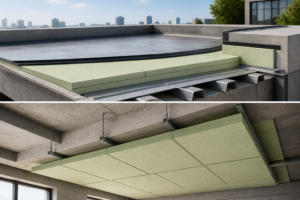
Insulation boards are the backbone of green building and sustainable construction, providing thermal barriers that reduce energy use by 30-50% while increasing occupant comfort and lowering carbon footprints amid rising climate challenges. These insulation sheets, especially extruded polystyrene (XPS) variants, help meet international standards like LEED and India’s ECBC, closing the gap between environmental goals and real-world performance.
Supreme Petrochem, a leading insulation company in India, examines the critical role of insulation boards in creating net-zero-ready structures through our INSUboard XPS range. From lifecycle analysis to real-world applications, this blog provides architects, builders, and policymakers with practical insights on using thermal insulation for the future built environment.
What Are Insulation Boards and Their Main Characteristics?
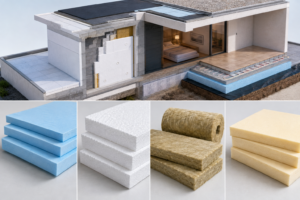
Insulation boards are rigid panels designed to minimise heat transfer, typically using low-thermal-conductivity materials such as XPS, EPS, or polyisocyanurate, with insulation sheets providing R-values of 4 to 7 per inch of thickness. In green building, their closed-cell structures—such as in XPS—resist moisture ingress (<1% absorption), ensuring stable performance over 50 years, unlike fibrous alternatives that degrade.
Building insulation using these boards prevents thermal bridging, a common flaw in 70% of conventional walls (US DOE, 2024). Supreme’s INSUboard exemplifies this, with a K-value of 0.0289 W/m.K and densities above 34 kg/m³, making it ideal for home insulation in humid tropical climates.
Key Properties Table:
| Property | XPS Insulation Boards | EPS Boards | Mineral Wool |
| Thermal Conductivity | 0.028-0.030 W/m.K | 0.032-0.040 | 0.035-0.045 |
| Water Absorption | <0.5% | 2-4% | >10% |
| Compressive Strength | 180-500 kPa | 100-200 kPa | 50-100 kPa |
| Lifespan | 50+ years | 30-40 years | 20-30 years |
This positions INSUboard, a foam board, as a sustainable frontrunner.
How Do Insulation Boards Help Improve Energy Efficiency in Green Buildings?
Thermal insulation boards reduce HVAC loads by stabilising indoor climates—insulation sheets on roofs alone can achieve 25-35% savings in cooling-dominated India (BEE Residential ECBC, 2025). They create high-R envelopes (U<0.4 W/m²K), lowering peak demand that strains grids during monsoons or summers.
Real insight: An iconic office building in South Mumbai retrofitted with insulation material and other energy-efficient equipment reduced electricity bills by 28%, per on-site metering, while increasing thermal comfort by 5-7°c. Home insulation applications extend this to villas, where insulation boards under slabs prevent ground chill.
The Environmental Impact: Lowering Carbon Footprints Using Insulation Sheets
Insulation boards reduce embodied carbon by substituting for energy-intensive materials—XPS production emits 3-5 kg CO2e/m³, compared with over 100 kg for concrete (IPCC LCA, 2023). Recyclable foam boards are reintegrated into lower-grade products, supporting circular economy requirements under India’s PWM Rules 2022.
Over their lifecycle, insulation sheets like INSUboard offset 200-300 tons of CO2 per 1,000 sqm facade through avoided grid emissions from 15–30% energy savings, far outperforming traditional masonry (TERI LCA Study, 2024). Supreme Petrochem’s HFC-free processes ensure zero ozone-depletion potential, making thermal insulation a key element for GRIHA and IGBC certifications, while reducing landfilling through mechanical recycling loops.
Insulation Boards in Certifications: LEED, IGBC, and GRIHA Compliance
Green building ratings depend on insulation material performance—LEED v4 offers 10 points for R-30+ assemblies with insulation sheets. IGBC requires U<0.4 for walls and roofs, which is exactly achieved by INSUboard’s 50mm layer.
GRIHA highlights this, attributing 12 points in energy optimisation to thermal insulation. Builders report achieving 20% faster certification with pre-tested insulation boards from a reputable insulation company in India, like Supreme.
Spotlight on Supreme INSUboard: Pioneering Sustainable Insulation
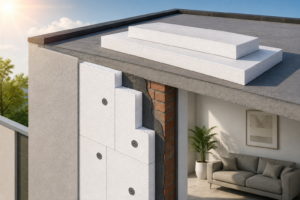
Supreme Petrochem Ltd, a leading insulation company in India, manufactures INSUboard insulation sheets at its eco-friendly Nagothane facility using HFC-free blowing agents to achieve zero ODP and GWP. These sheets are made of high-density XPS (>34 kg/m³) and are designed to meet green building needs, ranging from home insulation to commercial facades. Available in compressive strengths of 180-350 kPa, the foam boards feature ship-lap edges for seamless joints, reducing thermal bridges by 20% and minimising installation waste. They come in custom thicknesses from 20-100mm, suitable for over-deck, cavity wall, or flooring applications.
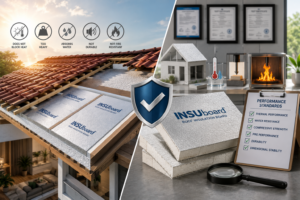
As Asia’s largest producer of styrenics, Supreme combines insulation material expertise with IGBC-certified INSUboard, providing nationwide technical assistance, including BIM models and site audits. This positions INSUboard as the preferred thermal insulation for net-zero projects, delivering lifecycle savings through excellent moisture resistance (<0.5% absorption) and dimensional stability in India’s humid climates.
Step-by-Step: Integrating Insulation Boards into Sustainable Designs
Achieve green compliance with this framework:
- Envelope Audit: Calculate U-values; target <0.35 W/m²K with insulation boards.
- Material Selection: XPS for moisture zones; insulation sheets >50mm.
- Installation: Mechanical fix for seismic areas; seal joints with tape.
- Testing: Blower-door (<3 ACH), thermography for bridges.
- Monitoring: IoT sensors track savings post-occupancy.
- Certification: Submit R-value proofs.
This fills retrofit gaps, common in 60% of Indian upgrades.
Comparing Insulation Boards: XPS versus Alternatives for Eco-Friendly Projects
Pros/Cons Table:
| Type | Green Strengths | Limitations | Best Green Use |
| XPS Foam Board | Low GWP, durable R-value | Higher upfront cost | Facades, roofs |
| EPS | Cheaper, recyclable | Higher absorption | Interiors |
| PU Spray Foam | High R/inch | Non-recyclable, toxic | Cavities |
| Rockwool | Fireproof, soundproof | Settles, heavy | Partitions |
Insulation sheets like INSUboard lead for holistic sustainability.
Challenges and Solutions in Implementing Insulation Boards for Sustainability
Key hurdles in deploying insulation boards include higher upfront costs—insulation sheets like XPS can increase envelope budgets by 10-20% compared to bare plaster—coupled with shortages of skilled labour, as improper installation accounts for 30% of thermal failures due to gaps or compression damage (ECBC Implementation Report, 2024). Regulatory gaps in smaller Indian cities delay adoption, while myths about foam board non-recyclability discourage green certifications despite proven mechanical reprocessing.
Builders address these issues through lifecycle costing, showing 3-5 year paybacks from 25-40% energy savings, plus MNRE rebates and Supreme’s free training programmes that certify installers nationwide. Partnering with a reliable insulation company in India, such as Supreme, offers pre-engineered solutions, BIM integrations, and on-site audits, ensuring thermal insulation delivers sustainable building performance while navigating local codes seamlessly.
Future Trends: Smart Insulation Boards in Net-Zero Construction
Emerging insulation boards incorporate IoT sensors and phase-change materials (PCMs) for dynamic thermal regulation, real-time heat flux monitoring, and automatic R-value adjustment to optimise energy use in net-zero buildings, with market forecasts indicating 40% adoption by 2030 (IEA Net Zero Roadmap, 2024). Aerogel-infused insulation sheets offer ultra-low thermal conductivity (0.015 W/m·K), enabling thinner envelopes that save floor space while meeting increasingly stringent Passivhaus standards in India’s smart cities.
Bio-based foam board made from agricultural waste and mycelium composites challenges petroleum XPS. At the same time, Supreme’s recyclable INSUboard maintains an advantage through proven scalability and cost-effectiveness for large-scale retrofits. Home insulation is advancing with self-healing polymers that seal microcracks, ensuring the longevity of thermal insulation amid climate volatility, positioning insulation companies in India, such as Supreme, at the forefront of this smart building insulation revolution.
Frequently Asked Questions
Insulation boards earn points in LEED/IGBC through high R-values and low U-factors, reducing energy consumption by 30-50%. Insulation sheets like INSUboard make compliance easier.
XPS foam board resists moisture/decay for 50-year R-values, and lowers emissions compared to biodegradable alternatives. Supreme’s eco-process enhances its environmental credentials.
XPS foam board resists moisture/decay for 50-year R-values, and lowers emissions compared to biodegradable alternatives. Supreme’s eco-process enhances its environmental credentials.
Yes, closed-cell insulation sheets maintain their performance during monsoons and heatwaves, unlike fibrous alternatives. Perfect for eco-friendly building insulation.