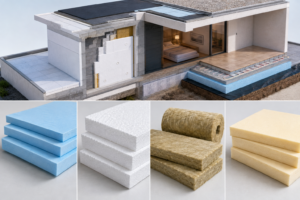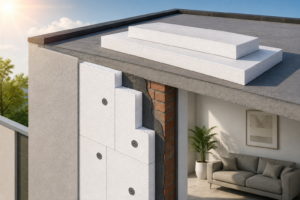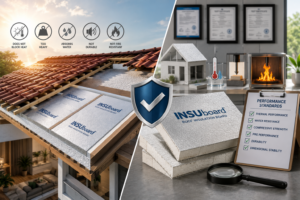
Urban India’s rooftops are transforming from simple shelters into lively, useful spaces. Roof gardens flourish with greenery, parking decks support cars over living areas, and refurbished flat roofs revive old structures. These ambitious projects require insulation that can withstand heavy loads, root penetration, vehicle traffic, and monsoon saturation, while maintaining thermal comfort below. This blog explains why INSUboard from Supreme Petrochem Ltd is the top choice for these applications, combining high compressive strength with proven durability in India’s harsh climate.
From lush terrace farms to busy podium slabs, INSUboard’s extruded polystyrene (XPS) boards perform where other roof insulation materials struggle. We’ll look at its use in over-deck insulation for green roofs, parking deck insulation board applications under heavy traffic, and flat roof refurbishment insulation that avoids full structural tear-outs. Using real project outcomes and technical specs, discover how this home insulation solution easily scales from residential terraces to commercial complexes, bridging crucial gaps in coverage for load-bearing rooftop transformations.
INSUboard’s Technical Superiority for Multi-Use Roof Applications
INSUboard Roof Grade boards achieve compressive strengths of 250–300 kPa at 10% deformation, supporting concrete pavers, soil depths up to 1m, and dynamic vehicle loads on parking decks. This is far better than standard EPS insulation ratings of 100–150 kPa. Their closed-cell XPS structure limits water absorption to under 0.7% by volume, preventing the 30–50% thermal loss seen in fibrous boards when saturated during monsoons. Thermal conductivity is steady at 0.028–0.030 W/m·K across thicknesses of 25–100mm, providing consistent R-values whether buried under garden beds or exposed to terrace weather.
Supreme Petrochem makes these insulation sheets without CFCs, ensuring GreenPro and GRIHA compliance necessary for urban green certifications. Standard 1.2m x 2.4m panels interlock perfectly, preventing thermal bridges common in poorly fitted under-deck insulation systems. This combination makes INSUboard the preferred parking deck insulation board for India’s mixed-use developments, where single materials often do not meet demands.
Why INSUboard Dominates Roof Garden and Landscaped Roof Projects
Roof garden systems subject insulation to specific stressors, such as constant soil moisture, root intrusion, and thermal cycling from dark planting beds that soak up solar heat. INSUboard’s impermeability blocks water from reaching structural slabs, unlike mineral wool, which can absorb 20–30% moisture. Its rigidity helps prevent soil settlement that can crack regular membranes. A 50mm layer beneath 600mm of soil keeps U-values below 0.35 W/m²K, maintaining indoor areas about 5–7°C cooler than uninsulated green roofs.
Root barrier compatibility highlights a gap in generic guides: INSUboard’s smooth, non-absorbent surface ensures that HDPE root membranes stick firmly without delamination, a common issue with porous boards. Residential towers in Mumbai increasingly specify it for terrace farms, where 15–20% energy savings come from reduced rooftop heat gain. Among insulation companies, Supreme’s nationwide supply chain offers the consistency essential for phased rooftop greening projects.
Best Parking Deck Insulation Boards for Podium Slab Construction
Podium decks supporting 5–10 kN/m² live loads require insulation that goes beyond thermal performance. Heavy vehicles create point loads that can crush lower-strength boards. INSUboard Floor Grade, with a compressive strength of 500+ kPa, withstands forklift traffic and car parking without distortion, maintaining flatness under screed or paver toppings. Its low weight (32 kg/m³) reduces dead load by 60% compared to concrete screed options, enabling thinner structural slabs that comply with NBC 2016 parking standards.
Vibration damping is an additional benefit: the cellular structure absorbs dynamic impacts, reducing noise transfer to residential areas below, a common complaint in mixed-use buildings. Developers in Delhi prefer over-deck insulation setups, layering 40–60mm boards above waterproofing to shield membranes from oil drips and tyre scuffing while ensuring a service life of 25–30 years.
INSUboard Applications in Flat Roof Refurbishment Insulation
Old flat roofs are a problem for India’s commercial buildings, with 70% built before 2005 lacking modern insulation. INSUboard enables overlay refurbishments that avoid costly slab demolition. Using 50mm boards on existing bitumen membranes restores thermal performance to ECBC standards at 40% lower cost than ripping and replacing. Mechanical fixings secure panels against cyclonic winds, while tapered variants allow for positive drainage, eliminating ponding that doomed earlier systems.
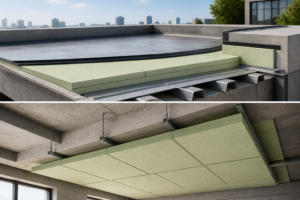
Installing under-deck insulation complements this method. Suspended 25–40mm boards beneath slabs create ventilated cavities, reducing surface temperatures by 8–10°C without structural penetration. Office retrofits in Bangalore report 22% HVAC savings in the first year, confirming lifecycle ROI calculations that are often overlooked in discussions focused solely on new construction.
How Polystyrene Boards Support Load-Bearing in Parking Deck Insulation
Unlike foam glass or PIR boards, which can fail under point loads, INSUboard distributes stresses evenly through its uniform cellular structure, preventing punctures from maintenance tools such as jackhammers. IS 1346 structural design codes acknowledge XPS boards can support up to 600 kPa for permanent loading, making them suitable for 150mm concrete toppings above parking slabs. This ability to transfer load enables developers to convert underutilised terraces into income-generating decks without strengthening columns.
Finite element analyses show minimal deflection (<L/500) under dead load and live load combinations, ensuring waterproofing integrity above occupied spaces. The material’s thermal expansion coefficient closely matches that of concrete, reducing shear cracks, a detail often overlooked in insulation comparisons.
Insulation Material Selection for Inverted Roof Garden Systems in India
India’s inverted roof garden systems place insulation above waterproofing, exposing boards to UV rays until ballasted. INSUboard’s resistance to weathering, with no degradation after 2,000 freeze-thaw cycles, ensures longevity beneath gravel, pavers, or planting media. Its tolerance for monsoon ponding sets it apart from EPS alternatives that absorb 2–4% water, which is critical when drains inevitably clog.
Among roof insulation materials, only closed-cell boards maintain R-value stability above saturated membranes. Geotextile separators obstruct soil fines from entering board cells, maintaining drainage capacity vital for root health and membrane protection. This systems approach addresses integration issues often glossed over in material-focused guides.
Benefits of INSUboard in Rooftop Garden and Terrace Construction
Rooftop terraces offer two advantages: home insulation below decks keeps interiors comfortable year-round, while high compressive strength supports outdoor furniture, barbecues, and jacuzzis that generate eccentric loads. Fire safety (Class 0 surface spread) meets urban regulations for accessible roofs, unlike some polymer boards, which require protective screeds.
Energy modelling shows that buildings with full INSUboard envelopes achieve 18–25% reductions in cooling loads. The boards’ shape stability prevents uneven walking surfaces as soil compresses, eliminating trip hazards and maintenance issues that troubled early green roof initiatives.
How to Insulate Flat Roofs for Refurbishment Using EPS Boards
Step 1: Assessment – Core test existing slab for load capacity (minimum 3 kN/m² dead load capacity needed).
Step 2: Surface Preparation – Power wash, fix honeycombs, and prime with bitumen emulsion.
Step 3: Waterproofing – Torch-apply APP membrane, avoiding open flames near existing insulation.
Step 4: INSUboard Layer – Stagger 50–75mm boards in adhesive bed, ensuring tight butt joints.
Step 5: Protection – Geotextile + drainage mat + 50mm gravel or pavers.
Step 6: Verification – Flood test assembly 48 hours before planting.
This process, refined through over 50 Indian retrofits, achieves weathertight performance on par with new construction with minimal disruption.
EPS Insulation Performance Under Heavy Loads: Parking Decks
Dynamic load tests simulate 20 years of traffic: INSUboard retains 98% of its thickness after 100,000 passes from 5-ton axles, contrasting with 15–20% compression in lower-grade polystyrene. Acoustic benefits also apply to vibration isolation, reducing structure-borne noise by 12–15 dB to apartments below, according to NBC guidelines.
Frequently Asked Questions
Its superior compressive strength (300 kPa) and water resistance (under 0.7% absorption) effectively manage soil loads and monsoons without thermal loss.
INSUboard Floor Grade exceeds 500 kPa, approved for 100–150mm reinforced toppings per IS 456.
Overlay systems bring ECBC compliance at 40–50% the cost of demolition and rebuild, with 25-year warranties.
Yes, the graded variants work for both applications, from membrane protection (overdeck) to cavity ventilation (underdeck).